
By: Rumaysa Drissi and Sumaya Abdel-Motagaly
Content warning: this article contains mention of sexual violence.
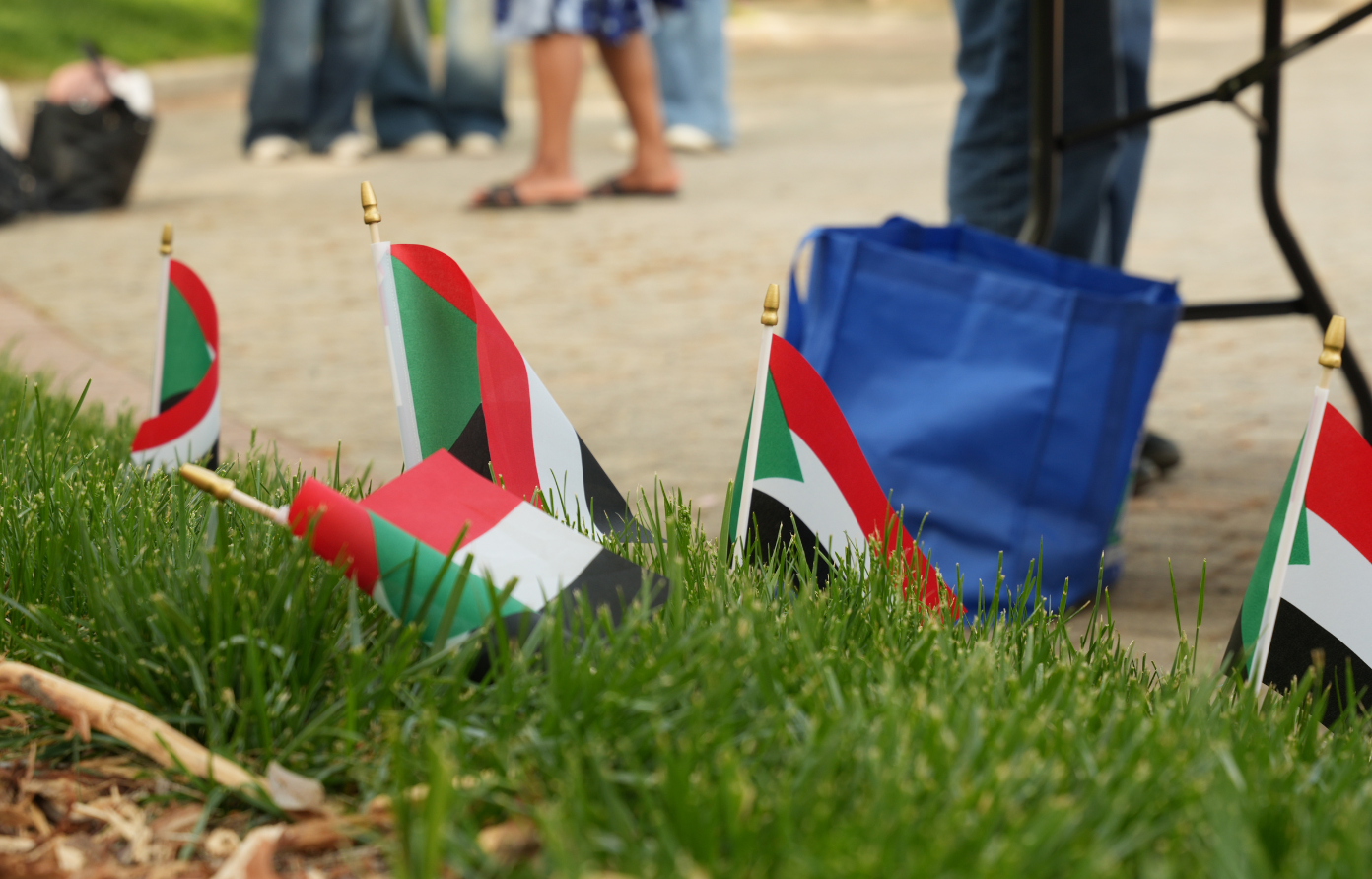
Sudanese flags stood upright, lining the grass across the borders of Hornbake Plaza. Chalk messages, calling for an end to the war and demanding more attention to the conflict covered the stone ground. To commemorate the third year since the war in Sudan struck, dozens of students gathered to hear speeches from student organizers and pray in a vigil Wednesday afternoon.
“What is happening in Sudan is not just war but devastation,” said Lena Elamin, with tears in her eyes. Elamin is the vice president of the university’s Sudanese Students’ Organization (SSO). “Sudan is not just a headline, it is not just a trend. It’s real people. It’s real pain. It’s my people.”

Since the start of the civil war and genocide in 2023, at least 59,000 people have been killed and 13 million displaced, according to the Associated Press, with humanitarian groups saying the death toll could be much higher but remains uncertain due to limited entry to the region. The war broke out as a result of a power struggle between the Rapid Support Forces (RSF), a paramilitary group, and the Sudanese Armed Forces (SAF), the country’s official military.
“It’s one of the biggest humanitarian crises that is happening right now,” said Elamin, a senior English major who is of Sudanese descent. “It’s so sad that no one is really talking about it.”
The vigil, hosted by SSO, featured student speakers from across various campus organizations such the Muslim Student Association (MSA), NoirUnited International and Students for Justice in Palestine (SJP).
“When Sudan bleeds, we all bleed,” said Zayd Mahfuz, the president of the MSA.

Mahfuz led the students in a prayer for the safety and well being of the Sudanese people. He emphasized the need for community solidarity and urged students to take action in advocating for Sudan by raising awareness about the war and supporting relief organizations.
“While we might feel small in the face of so much loss, we are not powerless,” he said. “Today is not only about grief, it’s also about hope. The people of Sudan continue to show remarkable faith, resilience and dignity in the face of hardship.”
Student speakers shed light on the sexual violence many Sudanese women are subjugated to. According to the United Nations Entity for Gender Equality and the Empowerment of Women, Sudanese women are disproportionately targeted and affected by the conflict. In a report released by the United Nations International Children’s Emergency Fund in 2024, 221 cases of rape have been recorded by Sudanese health providers.
However, many Sudanese women’s stories, like Elamin mentioned, often go untold.
“Many [Sudanese women] are not believed and many are left to carry their trauma alone,” Elamin said in her speech. “We have to say it out loud because the world won’t. It is happening right now. Why is there no outrage? Why [are] Sudanese women not being protected? Why are their lives, their dignity treated as if they do not matter?”

Temi Akinmola, a sophomore information science major who attended the vigil, noted the importance of communities supporting one another.
“It was important to come out and show my support and respect for the country,” she said. “We all have a duty. We’re all brothers and sisters and we should all uplift each other throughout our hard times.”
Image credits: Cover photo by Hamza Muhib for Al-Hikmah.
Leave a Reply