
By: Sumaya Abdel-Motagaly
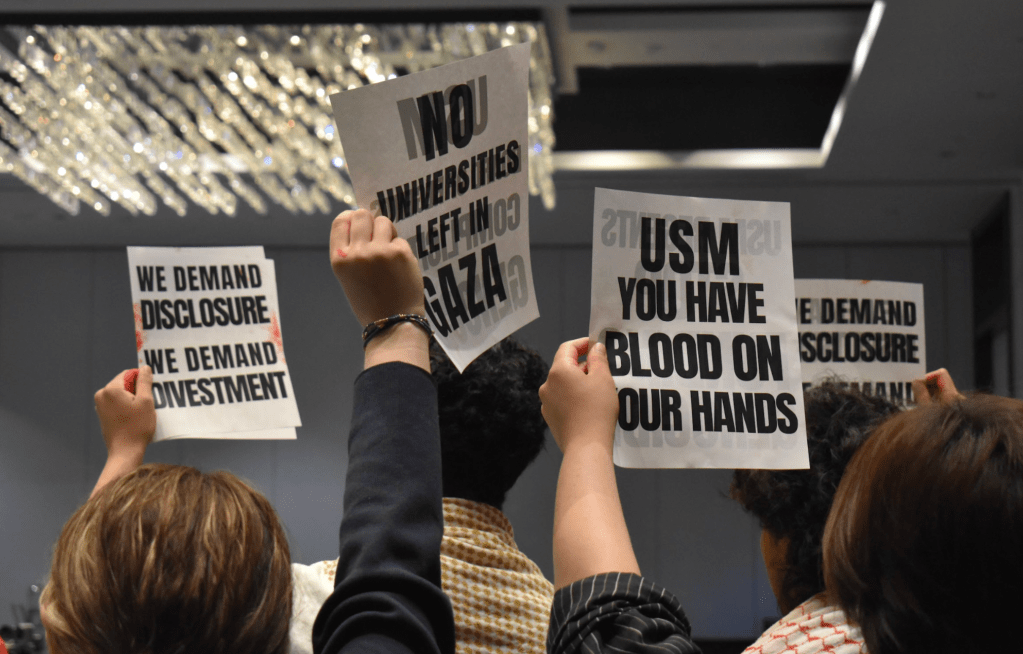
As the last student finished testifying during the public comments period of the University System of Maryland (USM) Board of Regents meeting, students in attendance collectively stood up and began chanting “disclose, divest, we will not stop, we will not rest.” Holding up signs reading “USM you have blood on your hands” with red paint symbolically smeared across their own, the students walked out of the meeting room, continuing their chants as they were followed out of The Hotel at the University of Maryland (UMD) by University of Maryland Police (UMPD) on the morning of Friday, April 17.
The walkout came ahead of the USM Divestment Coalition for Palestine “People’s Tribunal” which accused the USM Board of Regents, a panel of members who are responsible for overseeing public universities across the state of Maryland and who maintain control over the university’s endowment, of being complicit in the ongoing genocide in Gaza through USM’s investments in arms-producing companies.
The tribunal, which was also organized by Students for Justice in Palestine (SJP) chapters from UMD, University of Maryland, Baltimore County (UMBC) and Towson University sought to charge the board and others responsible within the USM on six formal charges of: financial complicity, academic complicity, military research, donor influence, institutionalized Zionism and political repression.
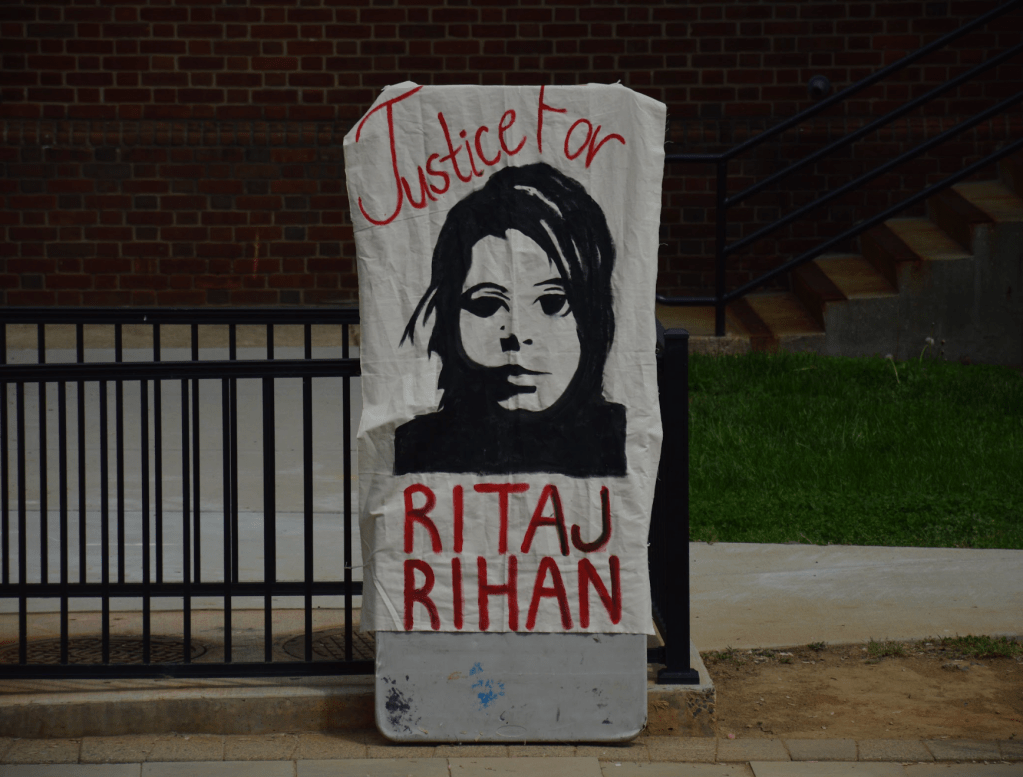
Approximately 100 attendees gathered in the Nyumburu Amphitheater, which they reclaimed as a liberated dome and renamed “The Ritaj Circle for Palestine” in honor of Ritaj Rihan, a nine-year-old Gazan girl shot in the head and killed by the Israeli forces while attending school, as reported by Middle East Eye.
“Through this tribunal, we the students reclaim our power,” said Khadeeja Abdallah, a member of the USM Divestment Coalition for Palestine, addressing attendees. “Today we commit to honoring Ritaj Rihan and the thousands of other martyred students in Gaza who are murdered by weapons our educational institutions invest in.”
Al-Hikmah did not receive a response to repeated requests for comment from the USM.
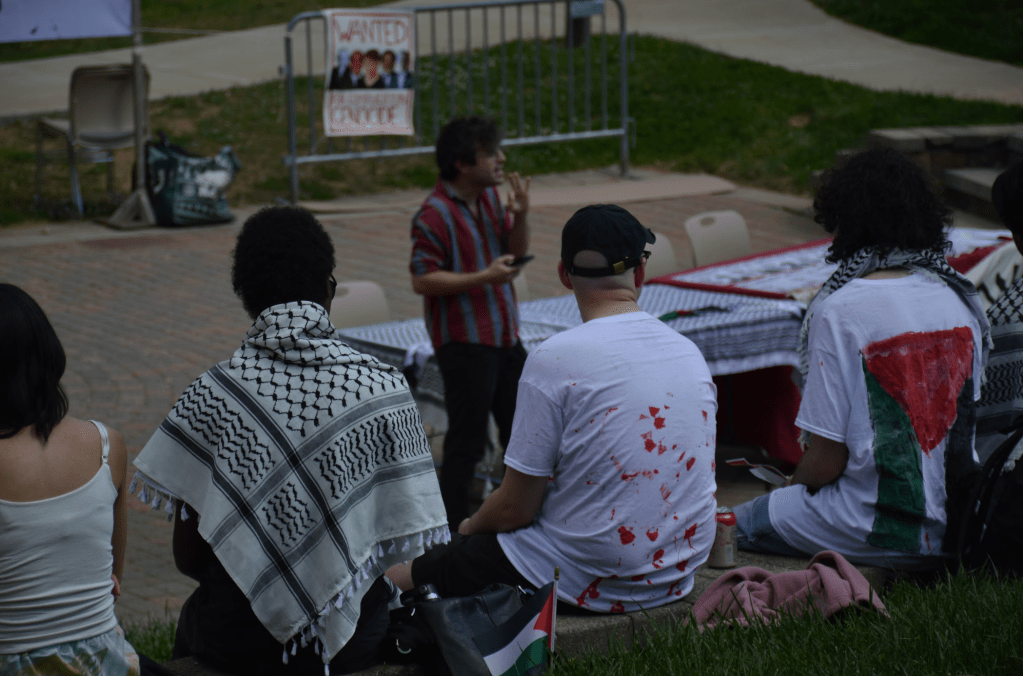
The People’s Tribunal served as a forum for community members across the USM to hear speeches and testimonies from students who have been silenced by institutional policies and human rights experts.
“We are tracing the path of colonial violence, resisting the narrative and defying the U.S-backed Zionist regime who attempt to erase the existence of the Palestinian people,” Anthony Reina, the regional coordinator for the International League of People’s Struggle said. “The power of tribunals like this is that it convenes people and unites us in both will and action.”
At the tribunal, speakers were prohibited from using sound amplification devices, as per university policy which restricts amplification to be at certain hours. Students said the policies are part of a larger institutional effort to silence pro-Palestine advocacy across campuses.
Zyad Khan, a UMD senior computer science major and member of the divestment coalition shared his experiences as a student activist, and how this university has attempted to repress students like him at the tribunal. He recounted the lawsuit UMD SJP filed and won against this university who attempted to ban students from organizing a pro-Palestine vigil on Oct. 7, 2024.
“[The lawsuit] wasn’t the starting case where we saw repression on this campus for Palestinian activism and organizing,” said Khan, who is also a member of this university’s SJP. “[These policies] silence students who organize for Palestine, not the students against.”
The day also coincided with Palestinian Prisoner’s Day, which is meant to shed light on the abuses and torture Palestinians face in Israeli prisions and recognize those still behind bars. According to B’Tselem, the Israeli Information Center for Human Rights in the Occupied Territories,over 10,000 Palestinian prisoners remained in Israeli Prison Services, as of December 2025. Many of these prisoners are held without charges or trials.
Recently this March, the Israeli Parliament approved a law which legalizes the death penalty by hanging for Palestinians convicted of murdering Israelis, as reported by the Associated Press.
Beshar Saidi, a Lebanese-American, was imprisoned by Israeli forces while visiting his wife’s family in occupied Palestine on Christmas in 1997. He was imprisoned for more than 18 months and recounted his experiences in a speech at the tribunal.
“I was struck,” he said recounting the torture he saw Palestinian prisoners faced. He endured 24 days of physical and psychological abuse before signing a confession for the charge of “providing service to an illegal organization” despite no evidence, according to The American-Arab Anti-Discrimination Committee (ADC).
Community members highlighted how this tribunal goes beyond just a symbolic effort, rather it serves as a call to action.
“It’s explicitly clear how the Board of Butchers [Board of Regents] is complicit in the genocide throughout the charges laid out,” Reina said. “Now, it’s our job to actually hold them to account.”
Image credits: Cover photo by Sumaya Abdel-Motagaly for Al-Hikmah.
 Al-Hikmah
Leave a comment