
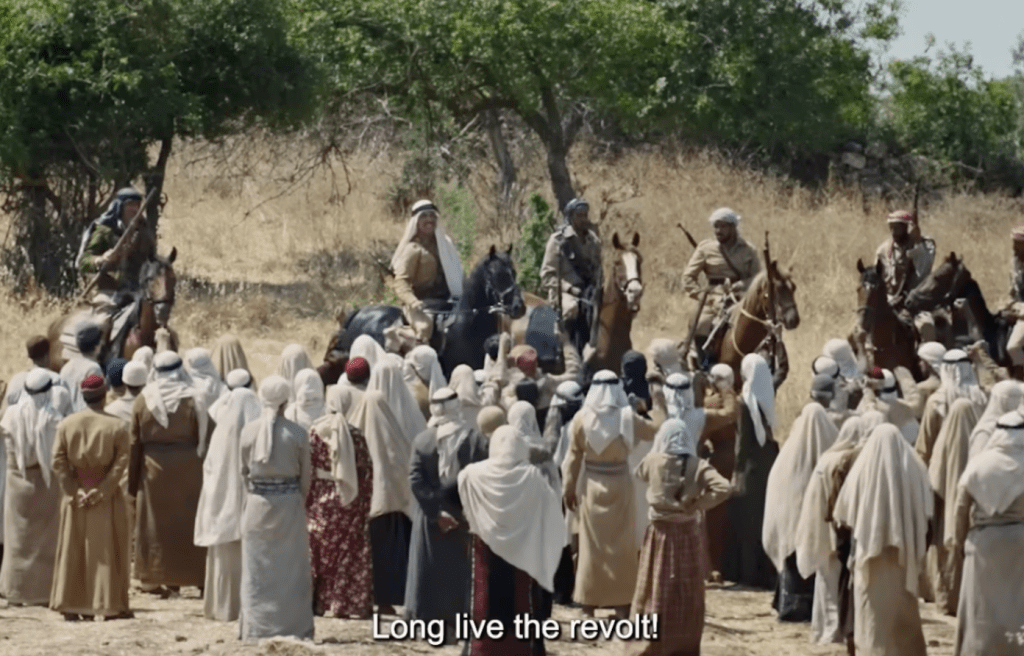
I must begin with a confession. If you asked me about the nitty gritty details of the Palestinian history as it explains the state of Gaza and the West Bank today, I would not be able to answer. History of the Middle East is something that for my entire life has been filtered through the lens of American media. If even one consumed what might be considered a “bipartisan” media diet, one could be forgiven for not knowing that Israel has had 5 separate wars with Palestine, killing thousands of Palestinians before October 7. We’re taught to view violence in isolation: One moment of pure death, rage, and carnage. One set of towers falling with thousands in them. One night when the Iron Dome failed.
For some reason, if you want to speak on behalf of a people being ripped from their ancestral land and homes as we speak, you must become a historian. Yet, if one were to watch Palestine 36, it feels as though it were made not only for Palestinians, but for the historically illiterate like myself. Transported back in time to the 1936-1939 Palestine Revolution (or Arab Revolt), a person sitting down for this movie might be forgiven for thinking we’re going back to the mythical “where it all started” question — a question our media has deemed of critical importance in determining the answer to saving innocent families and feeding starving children. Palestine 36 on the other hand does not care about stupid questions. It seeks to make real the death and carnage which has been ripping through the region since the end of the First World War. It gives voice to a people who have been silenced for over a century. It gives permission to not only Palestinians, but all those who would aid them, to mourn every tragedy that has befallen the ailing nation since the Balfour Declaration. And for people like me, it is a window to a tragic and somber past which continues to be forgotten and diluted.
Perception, Palestine, and postmodernism
The word postmodern is highly volatile. FOX news will throw it around in articles without definition talking about moral decline in the world and oppression of white Christians. Prominent Muslim thinkers like Dr. Yasir Qadhi discuss it as it relates to their dissertations. The truth is however that this word has been used and abused, and in public discourse has lost much of its meaning. While there are many facets to it, an important element is that postmodern thinkers suggest that we live in a cultural condition that deludes us into thinking we’re in an eternal present, with no real connection to the past. Frederic Jameson describes in his essay Postmodernism, or the Cultural Logic of Late Capitalism, a society, “…bereft of all historicity, whose own putative past is little more than a set of dusty spectacles.”
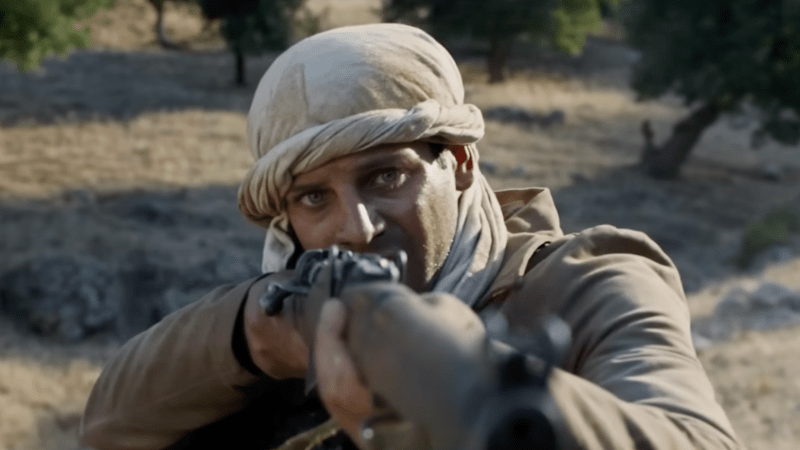
Palestine 36 then, in its own way, is a revolt against this condition. Today, we only perceive Palestine, Israel, and the U.S. as the actors in this genocidal theatre. Yet, in the opening scenes of the movie, it is the British Empire kicking things off with the inaugural broadcast of the Palestinian Broadcast Service. This opening scene singlehandedly gives not merely a Palestinian audience, but a global audience the chance to relate and remember. A Pakistani person watches as he sees the same British who partitioned the subcontinent. A Chinese person sees the same British who cut their country up with the Opium Wars. Little needs to be said of an African person who would see their ancestors’ buyer, seller, and colonizer all wrapped up into one. In a few minutes, director Annemarie Jacir forcibly reconnects us with the reality of colonial oppression, and the somber reality of those same colonizers now having completely shirked any responsibility for what followed.
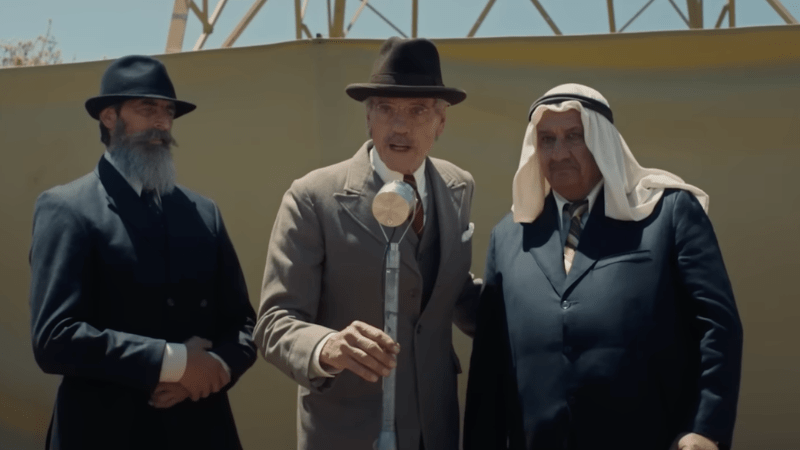
In the same scene, the British discuss the purpose of the radio service about to be launched, and blend blunt racism with trite attempts at wrapping it in subtlety. The High Commissioner Arthur Wauchope (Jeremy Irons) immediately says on this radio, “…[will] not be concerned with politics…” but not soon after says he hopes it will be used to “…explain [to countryside farmers] the advantages of various kinds of means of cooperation.” As is shown later in the movie, the revolution in question had a strong countryside presence as the British refused to support the villagers, who complained of settlers literally setting fire to their crops. Perhaps the most poignant symbol from this entire scene however, is when the radio officially launches. In a display of unity, a settler representative speaking in Hebrew, a Palestinian representative speaking in Arabic, and the Commissioner himself speaking in English, all say the first lines into the broadcast. On the surface, a beautiful gesture, demonstrating the genuine hope for goodwill and reconciliation the British colonizers hope to create between the settler Jews and Palestinians. Yet, they say their lines in a certain order: The Commissioner goes first, then the settler, then the native Palestinian. The colonizer first, his patron second, and the native they both take land from last. Even when the colonizer thinks they are being merciful and just, in the cultural logic of this practice is an innate, unconscious disrespect for the people colonized.
Once upon a time
Not soon after this broadcast is launched, a little girl and her mother walk through some hills towards Village Basma. On this small pathway is an oil pipeline, and to the side, a settler colony. The girl, Afra (Wardi Eilabouni), asks two simple yet powerful questions. The first, “Why are there fences around the colony?” The second, “Why do they come to live here?” Questions of pure curiosity, absent of malice. While she never gets an answer to the first, her mother, Rabab (Yafa Bakri) replies, “Because their countries don’t want them,” to her second question. Rabab had likely seen a time when that colony wasn’t there, and the hills around her village were truly free to roam for any Palestinian. Yet, she places empathy in the heart of her daughter, choosing to believe that the settlers genuinely just want a place to stay and nothing more. They cross the path and return to their village in peace and quiet.
A bit later, one of the film’s main characters, Yusuf Bassawi (Karim Daoud Anaya), attends a party hosted by the wife, Khuloud Atef (Yasmine al-Massri), of his employer, Sir Amir Atef (Dhafer L’Abidine). He meets one of the Revolt’s primary antagonists, Captain Orde Wingate (Robert Aramayo). What makes this odd, however, is that Wingate just arrested Yusuf’s little brother based on a complaint from the settler colony setting fire to his village’s crops of “armed bandits” interfering with them. What actually happened was that the village wanted to negotiate with the settlers themselves and sent a delegation which included Yusuf’s father. As they approached the colony however, a settler guard from a tower shot and killed Yusuf’s father almost immediately after spotting them. When Captain Wingate came the next morning to search the village for the arms the settlers accused them of having, Yusuf’s little brother tried to forcefully drive them out of his house, asking, “Can we not mourn our dead in peace?!” He was tied to the front of a car and driven away as the villagers, completely helpless, simply threw rocks at them as they left. However, instead of describing the village in barbaric terms like you’d expect a man who just raided it for weapons to do, Captain Wingate instead says it’s a “good village,” seemingly betraying a care for its people, but he immediately reveals his greed of it by describing it with, “fields of gold.” He nearly recognizes Yusuf, who pleaded with him directly to spare his brother as he was arrested, but the General Strike cuts the city’s power, causing him to leave and deal with the situation.
After the escalations to snuff out the rebels continue, Arfa and Rabab are walking down that same path with the oil pipeline, only this time, there are two British patrols who search for them. Not too long after, Father Boulus (Jalal Atawil) and his son Kareem (Ward Helou) attempt to return to Basma before the recently imposed curfew and are similarly stopped, but also robbed. Despite this blatant evil, Father Boulus tells his son they must learn to outlast this oppression: “You need to endure, so you can win in the end.”
Not long after, Sir Amir Atef, Khuloud Atef, and some collaborators eagerly await the Peel Commission’s decision on how to deal with every problem the movie has presented. Working for the Commissioner, Thomas Hopkins (Billy Howle) is one of the only people in British employment sympathetic to the Palestinian cause, and he rushes into Sir Amir’s house to warn them of terrible news: There will be no independent Palestinian state, Palestinian populations will be forcibly moved, and the land itself is likely to be partitioned. The radio only confirms the horror, as the film directly quotes the real-life Peel Commission report trying to appease the Arabs by saying, “half a loaf is better than no loaf at all.”
In the final scenes of the film, Father Boulos and others from the village have been arrested, having been compelled to reveal the location of the weapons the villagers were hiding for the rebels since the continued escalations through 1937. Kareem watches in horror, however, as the bus carrying his father is blown to bits barely some hundred feet away from him; someone had planted an explosive on the road leaving the village. Yusuf, who had since joined the rebel cause and helped procure the weapons, is killed as he throws a grenade into four British before getting shot. As the raid began, Arfa was sent off by her mother, told only to “run, and don’t look back.” Arfa’s home, being where the empty holster for a gun she hid the previous year near the village was found, is wired for detonation, ostensibly to destroy whatever else it may be hiding. Arfa’s grandparents, however, refuse to budge from their home, and instead of forcing them out, the soldiers detonate the house with the grandparents inside of it. As though that were not sufficient to scar the village for many lifetimes, they are made to dig the graves of their own dead, after which the British set fire to their village.
All of the above is a kind of violent horror. It stuns the senses, seeming as though this were a tale in some fantasy book or from a kingdom in the Dark Ages. It is the kind of horror one needs to live through in order to truly understand. Yet, throughout the film, there are smaller, more subtle horrors: The promises you never thought needed protecting getting broken again and again. Once upon a time, a mother and daughter, a father and son, believed they were promised the freedom to walk with their children in the hills without fear. Once upon a time, Captain Wingate believed that Basma promised the British Empire fields of gold. Once upon a time, Commissioner Arthur promised the radio would be used to spread Palestinian music and culture. Instead, Arfa and her mother will forever fear the hills and the soldiers that roam them. Villagers will remember Father Boulus and Kareem being robbed by British soldiers on the way home. And all of Palestine will remember how the Peel Commission, instead of Palestinian culture, music, and information helpful to their cause, used that radio to inform them of their incoming demise. The horror of bullets and blasts directed at you lasts only for as long as you can see them — the horrors that led to them happening, however, are the ones that send shivers through the spines of generation after.
This film is banned for screening in Israel over terrorism concerns. Yet, the main opponent in the movie is the British, who as the movie goes to show, were very comfortable in their roles as progenitors of terrorism and violence in the region. When the question of Jew and Palestinian comes up in the movie, either you get an answer like Afra’s mother, or like the laborers who discovered a barrel of weapons going to Tel Aviv while working overtime… who were then docked their overtime pay. They complain only that the Jews have it better, and they blame the British for not treating them equally.
Postmodernism once again rears its ugly head, as a century of media whitewashing would lead one to believe the Palestinians were always hostile in action and intent to the homeless settlers. Palestine 36 sets the record straight: Palestinians and Jews do not hate each other. Rather, the Palestinians were used as shields (a phrase our media landscape is quite fond of) for the British Empire’s racist and incompetent solution to the crisis of Jewish displacement in the wake of World War I. Then, instead of seriously attempting any political or social organization which may promote genuine, compassionate cooperation between the two, the British gave the settlers barbed wire to wrap their colonies in and guns to point at villagers. While, rightfully so, we can hold the Zionist entity in Palestine accountable for their comfort with ruthless disregard for Palestinian life, Palestine 36 forces us to reckon with the reality that this culture was not spontaneously born inside the settlers, but in major part taught to them by the British.
Sounds of agony
I’ve been poetic about the themes and message of the film, but the lasting horror this movie left within me is not the knowledge or even the sight of what happened. We don’t see Arfa’s grandparents’ corpses. Yusuf doesn’t make a sound as he is killed. Father Bolous doesn’t even have the chance to scream as the bomb underneath the bus rips him to shreds in an instant. Palestine 36 tells us the death colonizers have thrust upon the Palestinians is a spectacle of violence and speed, with no time even to process the loss of life before the next tragedy occurs.
This film shows us the true horror is with those who live to tell the tale, in particular via its brilliant use of sound design to communicate that horror.
Coinciding with the arrival of the Peel Commission is a brief period of apparent goodwill between the settlers and Palestinians. We’re treated to a sweet scene of the villagers selling their wares in the city market, completely untouched, smiling and laughing with one another. Out of nowhere, an explosion rips through the market. If you’ve watched the movie, you know what this sounds like — the sound of stone crashing into the ground rumbles through the market first. Then, it’s quickly replaced with the sound of dust flying all over the place, almost like ten snakes hissing around your head, evolving into a long-winded, unending shriek overwhelming you, like a needle being slowly driven through your skull. But in the midst, you hear them. Screams. Cries for help. Sounds of life desperately holding on, mixed with sounds of death racing through the city. And you can’t hear it, but you feel it; that another wave of these horrible voices will break out any minute.
As Arfa’s parents are killed, you hear the beginning of the market’s explosion again. The thick crash of rock against rock, but this time, the shriek isn’t your mind suffering the whiplash from a shockwave. Instead of overwhelming you, like a spider that creeps up in the night, you feel a terror set in rising with the wails of the villagers who witnessed their beloved elders get callously killed. Unlike the overwhelming ring of the bomb blast, this doesn’t cause physical pain. It starts like any other scream, but devolves into a mess of too many things: Small pauses to breathe in-between the sobbing, a guttural roar mixed with a scream from a spring of rage overflowing. Though the cadence never changes, it waxes and wanes as the villagers move and retreat and bend and rise, changing where their voices travel. Whereas the eerie quiet after a bomb explosion eventually blends with the din of everyday life to let the fear melt away, this kind of scream is haunting. It is the kind you hear in your nightmares, the one you fear is trapped within you, clawing at your throat and begging for release. It is the scream of your heart and mind when your tongue is silenced. It is the scream of your whole being as a part of it is mercilessly ripped from you, be it your family, your home, or everything in between.
I won’t forget the sounds this movie left me with. And as the movie ends, you see it in the eyes of the few who remain: they will never forget them either. Arfa will never forget the sound of her mother crying as she begs her to leave the village. Rabab will never forget the bang that announced her parent’s death. Yusuf could never forget the sound of calm indifference he was met with when he pleaded for his brother’s safety. And when these are the sounds that haunt your silence, the movie ends by showing us two choices.
Kareem takes the gun that Rabab hid, the holster for which betrayed his entire village and killed his father, and calmly walks to the city. His face, once soft with childish carelessness and a smile bright enough to make even the sun look dim, is absent both its happiness from a life long gone and twisted anger present when he was robbed by the soldiers. Every step is made with intent and measure of a man far beyond his years. Upon seeing the first soldier he can in the city, the wave of calm rapidly evaporates as his eyes ignite, his entire expression contorting with rage as he raises the gun that killed his father and simply aims at the soldier. We don’t know if Kareem had ever met this soldier, or if this soldier was part of the raids on his village, but to the young boy, there was no other way. After all he had was taken, he had no choice but to go and point a gun at the nearest occupying soldier, and fire, likely to have been killed swiftly in return and join those who fell before him. The first option is to abandon hope, as Kareem did when he walked straight into the jaws of death.
Rabab, on the other hand, stays in Basma, even though the surviving villagers are no longer there. Her reasoning is very simple: “Arfa only knows to find me here.” She stays in the graveyard of her people, hoping against all odds her daughter will find her way back, in brave solidarity with the words of her murdered mother to Arfa barely a year before: “Your land is where your people are buried.” The second option is to hold on to hope even more doggedly than before, having full conviction all this loss wasn’t for naught.
These two choices are summed up by a rebel much earlier in the movie. Khalid (Saleh Bakri) was one of the workers who discovered the shipment of weapons to Jewish settlers while working overtime. When he went to claim his overtime, he was not paid, and when he insisted he was beaten. As the people who’d go on to make up the rebel squads lamented their situation, Khalid laid the stakes of these thoughts very clearly: “Bread, or bullets.” Kareem chose bullets. Rabab chose bread, in hopes she can share it again with her daughter one day. It is tempting to blame Kareem or Rabab for either choice, but the truth is there is no one watching this movie who could understand the exhaustion in Rabab’s face or the fire in Kareem’s eyes by the end.
Palestine 36 does an excellent job retelling the long-forgotten woes of the Palestinians trapped between bread and bullets. It renders their cries unflinchingly, and their horrors openly, but it does not choose as Kareem does at the end. It is not a nihilistic film. It presents this terror to us in the hopes that the apparent dichotomy changes to an obvious, simple choice. It reminds us of the same dichotomy civilizations long past have had to reckon with and invites us to ponder how we, thinking we live in this world untouched by the legacy of colonialism, would resolve this dilemma. It offers the entire world its version of that answer.
Palestine 36 is a piece of art that asks the world to choose bread.
Image credits: Cover photo screenshot from YouTube.
CORRECTION: A previous version of this story had a spelling inconsistency with the Palestine: 36 character Yusuf’s name. This story has been updated.


Leave a Reply