
By: Iman Neja
“I’m going to call you what you are. Y’all are white supremacists! Y’all are complicit in genocide, and y’all are going to continue doing it!”
These are the words shouted by Mohammed Salih, a University of Maryland (UMD) student and member of the coalition of Nyumburu student ambassadors as he was escorted out for disrupting a University System of Maryland (USM) Board of Regents meeting after demanding to know what the USM would do regarding the Ku Klux Klan imagery that was in a document that a UMD tennis club had sent to Howard University in October.
The disruption came on the morning of Nov. 13, 2026, when the USM Board of Regents met at one of the twelve universities in its public higher education system, the University of Maryland, Baltimore County (UMBC).
The meeting was held on the third floor of the University Center, where there were more security personnel than students. Attendees could only enter the room after walking through a metal detector and having their bags searched.
The USM Board of Regents, a 21-member board that governs the University System of Maryland, convenes to “oversee the system’s academic, administrative, and financial operations; formulate policy; and appoint the USM chancellor and the presidents of the system’s 12 institutions,” according to the USM website.
For just 3 minutes — and only after gaining prior approval — students and faculty could address the board during a 15-minute public comment period. Students and workers from UMD and UMBC’s Students for Justice in Palestine (SJP), the UMD Graduate Labor Union (GLU) and UMD and UMBC’s American Federation of State, County and Municipal Employees (AFSCME) unions spoke.
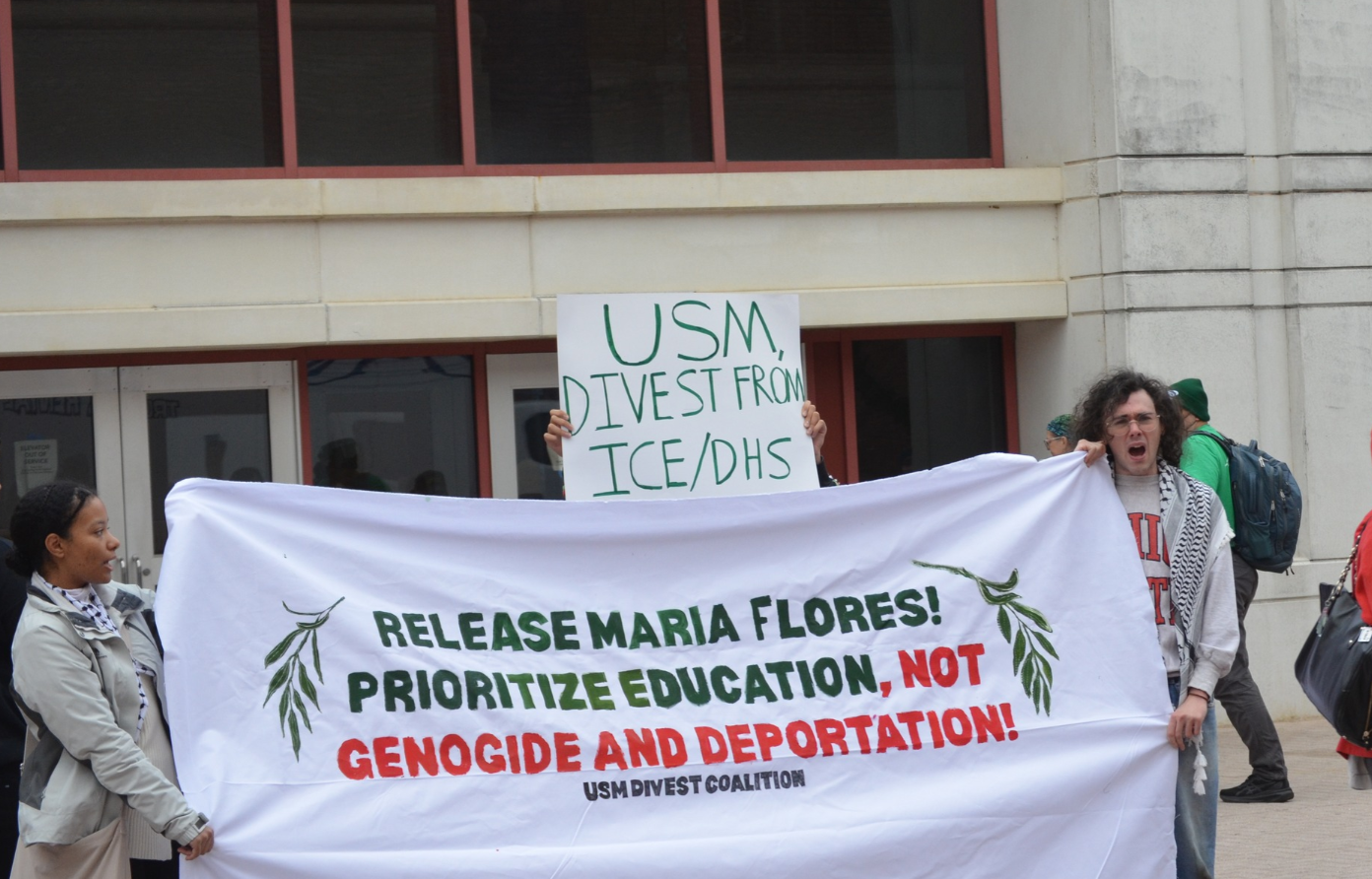
Students from UMD and UMBC’s SJP chapters demanded that USM disclose its investments and divest from companies that profit from or are complicit in human rights violations in Palestine and elsewhere. They also called on USM to take action regarding Maria Flores Garcia, a UMD student detained with her mother while visiting a USCIS office, and to make the universities within USM sanctuary campuses.
“How are students supposed to feel safe knowing their university invests in companies committing human rights violations not only in Palestine but also in Sudan, the Philippines, the U.S.-Mexico border, and so many other places around the world?” questioned Jenna Awadallah, a junior representing UMD SJP, urging the board to reconsider its investment policy.
“It has been over three years since the start of Israel’s genocide in Gaza, and over 75 years of displacement, occupation, and apartheid in Palestine. Since the beginning, students have made their stance clear. We do not want our money invested in companies supporting and perpetuating the genocide against Palestinians,” she said.
Charles Reisner, a graduate student from UMD, also called on the USM to stop lobbying against the Graduate Labor Union at UMD in the Maryland legislature in its “10-year fight” for UMD recognition of collective bargaining rights for student workers.
“If the assembled board members take anything away from this appeal, it should be the fact that we, as a prospective collective bargaining unit, are not going away,” he said. “We’ve also pulled and identified appointment security, higher wages, and better support and protections for our international graduate workers as our top priorities.”
Members of UMD and UMBC AFSCME unions spoke against the USM’s layoffs. They called on USM to reinstate the jobs of those who’d been laid off, especially those of mental health service workers.
“Three in five employees have struggled to pay for basic necessities while working at USM, like utility bills, groceries, and rent,” said Debbie Michaels, president of AFSCME Local 1459 at UMBC, reading remarks from Jontae Thomas, president of AFSCME Local 1297 at Bowie State University.
“The university cannot claim to prioritize student well-being while dismantling the infrastructure designed to protect them; it cannot ask students to seek help while making that help harder to access, or expect mental health professionals to care for others while denying them the support they need to care for themselves and students,” said Sarah Eppley, a union steward for AFSCME Local 1072 representing over 4,100 staff at the University of Maryland College Park and Global Campus.
After the public comment period ended, UMD and UMBC SJP students marched outside, chanting: “Disclose, Divest, we will not stop, we will not rest!”

Their protest, held on the steps of the University Center, featured hand-drawn signs and banners, including one that read, “Justice for Ritaj Rihan.” She was a 9-year-old Palestinian schoolgirl who’d been shot in the head and killed during a math lesson at Abu Ubaida Bin al-Jarrah School in Beit Lahia, northern Gaza, by nearby Israeli forces.
Nicole Morse, a Jewish associate professor at UMBC, spoke outside, urging the Board of Regents to divest from entities that are directly responsible for or complicit in war crimes, crimes against humanity, and genocide, said: “This is not only a moral necessity, but as a policy approach, it is a historical necessity.”
Having spent several months volunteering in the West Bank with Palestinian farmers practicing nonviolent resistance to ethnic cleansing, Morse said: “I witnessed late-night attacks by settlers, who are supported by the Israeli army as they drive families from their homes of 40+ years. I sat with children who are traumatized from watching their parents be beaten by settlers and the army.”
“How can the University System of Maryland claim to value student safety, human rights, and inclusion while allowing its institutions to remain connected to systems that contribute to violence, displacement, and the violation of those same rights?” said Razan Masri, a student from UMBC SJP.
“Our universities should be places where students feel safe, supported, and protected, not places where their rights and security are compromised,” she said.
Organizers of the USM Divest Movement plan to return and reiterate their calls for divestment at the Board of Regents meeting on December 11 at Towson University.
Image credits: Cover photo by Iman Neja for Al-Hikmah.
Leave a Reply