
By: Juno Callen
In a two minute attack-ad posted by the Mike Rogers campaign’s official X account on Thursday, October 6, Michigan Republican Senate nominee argued to voters that his opponent’s “radical ideology” and supposed ties to terrorist groups pose a threat to national security.
“I served as an army officer, an FBI special agent, and the chairman of the House Intelligence Committee,” Rogers said. “I know a threat to America when I see one.”
Dr. Abdul El-Sayed, the Michigan born-and-raised son of Egyptian immigrants, has consistently faced accusations of religious radicalism throughout his Senate run. Drawing on racial anxieties, particularly those surrounding Muslim Americans, has long been a hallmark of GOP strategy in the Trump era. President Trump himself has a particular dislike for El-Sayed, describing him at a recent campaign rally as a “jihadist” who “will have to go through a metal detector before he’s allowed to go into the senate.”
However, with El-Sayed leading in virtually all prominent polls, political scientists and pundits alike are skeptical that such racialized attacks are resonating with Michigan voters. The success or failure of the left-of-center candidate will be highly consequential as both parties attempt to reorient their platforms for the post-Trump future.
In addition to possibly deciding which party controls the Senate, if elected, El-Sayed will be its first Muslim member. Like many Muslim politicians before him, El-Sayed faces an uphill battle to win over voters.
“It’s going to be harder to gain votes, even if you had the exact same policies as a Christian white person. You’re still running at an inherent disadvantage,” said Michael DeWeaver, president of the UMD College Democrats. “But with all that being said, his way of campaigning is all very refreshing and exciting for voters. The real question is does his identity combined with his politics create an image of someone that is too extreme?”
Progressive policies like El-Sayed’s, including medicare for all and campaign finance reform, are gaining popularity among voters nationally, but these messages may be interpreted differently coming from a Muslim figure. U.S. vice president J.D. Vance certainly believes this to be the case.
In a closed-door meeting in September, Vance advised House Republicans to target El-Sayed in their messaging if their own opponents are not “that crazy.” In a recording obtained by CNN, the vice president contrasted El-Sayed with the Texas Democratic nominee, James Talarico (a white Christian).
“Talarico has said a lot of weird stuff. Let’s be honest. But that’s true of a lot of these candidates,” Vance said.

Dr. Nour Halabi, an interdisciplinary fellow and vice-chair of the Race, Ethnicity and Post-Colonial Network of Media Studies Association at the University of Aberdeen, believes that attacks on El-Sayed’s identity may not necessarily resonate with voters.
“He’s been effective at figuring out ways to throw out the rule book and go write,” Halabi told Al-Hikmah. “What does it mean to engage with the public as a human being? What do human beings right now care about in my city? What is causing them worry when they put their head on the pillow at night, and how do I address some of their concerns outside of labels and this and that?”
Halabi compared El-Sayed’s campaign with that of current New York City mayor, Zohran Mamdani. Mamdani faced similar attacks for his Muslim and immigrant heritage during his 2025 run.
“I think a lot of the sort of dog whistle politics, the racialized rhetoric, none of it really stuck to these two candidates, and that is worth trying to understand for the Muslim community but also for the Democratic Party,” Halabi said. “It’s been interesting who got people enthusiastic, who resonated with people, what works, and the fact that it’s coming from some really marginalized identities should make the Democratic Party ask some really real questions of itself.”
Blake Ruszula, vice president of the UMD College Republicans, attributes El-Sayed’s success to different factors. Ruszula is very open about his dissatisfaction with the Republican contender.
“He is a boring guy. He’s not a Trump,” Ruszula said of Rogers. “I’ve never watched a Trump press conference and found it to be boring. Same with El-Sayed.”
Ruszula believes El-Sayed’s biggest advantage lies in his ability to captivate an audience.
“There’s a lack of personality, and say what you want about El -Sayed, he definitely has a personality. People can describe him in two sentences where with Mike Rogers it’s gray, and that’s not what you want in a candidate,” Ruszala told Al-Hikmah. “There’s definitely something to be said about how American politics prioritizes personality over capability, but you know, it’s the system we live in.”
In the 2016 election, Trump was able to appeal to working-class white voters through his populist messages that connected their economic instability to their racial anxieties. He told them that illegal immigration and jobs being shipped overseas were why they were struggling to make ends meet eight years after the Great Recession.
In that election, and again in 2020 and 2024, Trump won rural Michiganders handily. UMD political science professor Dr. James Gimpel explained to Al-Hikmah over email that these areas historically lean Republican because of “religious conservatism, doubts about rapid cultural change, gun rights and outdoor culture, less exposure to racial diversity, and distrust of urban centric governance.”
Rogers, who has openly campaigned with Trump throughout this cycle, now must court this same electorate in a time of similar economic turmoil. However, Trump is now seen as the perpetrator of this hardship and not a potential savior. The most recent New York Times/Siena poll of the likely Michigan electorate found that 44% of non-college educated white voters strongly disapprove of Trump’s handling of the economy. The same poll found Mike Rogers still leads on cost of living with this category of voters, however.
The connection of financial hardship to the fear that the white race was losing status in American society is what has thus far allowed Trump to excel with many white working-class voters. However, both components of that argument are necessary, and Trump’s message this cycle is that the financial hardship Americans are experiencing is not real. “We have the single greatest moment in the history of our country in terms of the economy,” the president said in a White House event only two weeks before election day.
Without the backing of populist economic messages, Trump and Rogers’ attempts to stoke racial animus may fall flat this election. Michigan conservatives too disillusioned with Trump’s handling of the economy to support Rogers may turn to El-Sayed, but more likely they will stay home. Either outcome could greatly benefit El-Sayed in such a close race.
Which candidate will win the favor of Michigan’s diverse electorate remains to be seen. “El-Sayed has vulnerabilities, but he could still win. A lot depends on voter turnout,” Gimpel said.
As both parties evaluate their post-Trump futures, leadership must consider whether El-Sayed’s focus on everyday issues and willingness to connect with his constituents on a personal level allows him to overcome appeals to fear and cultural division.
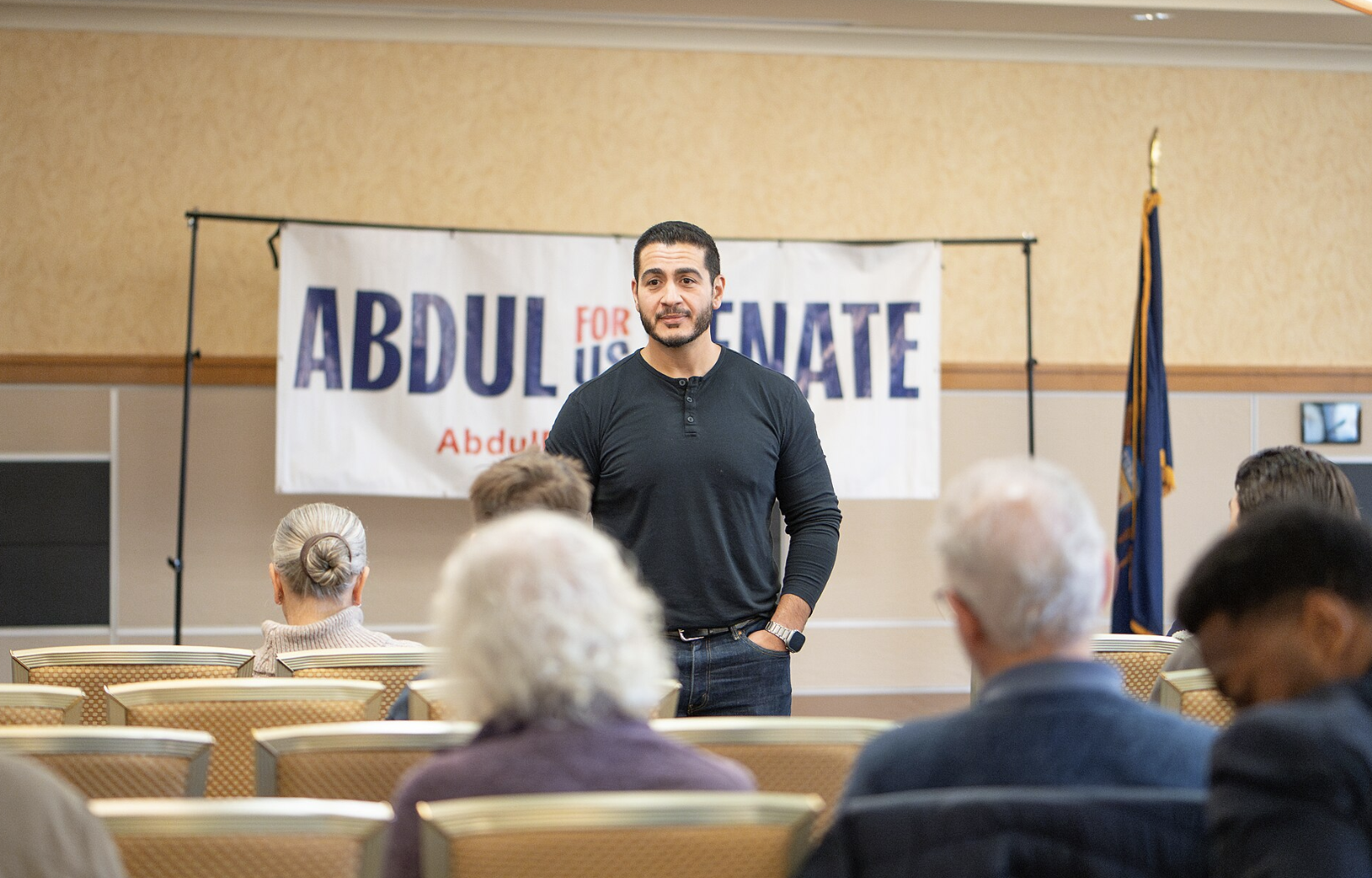
Cover photo used under CC BY-SA 4.0 license. Photo by Conlan Houston. Link to original image.
Leave a Reply