
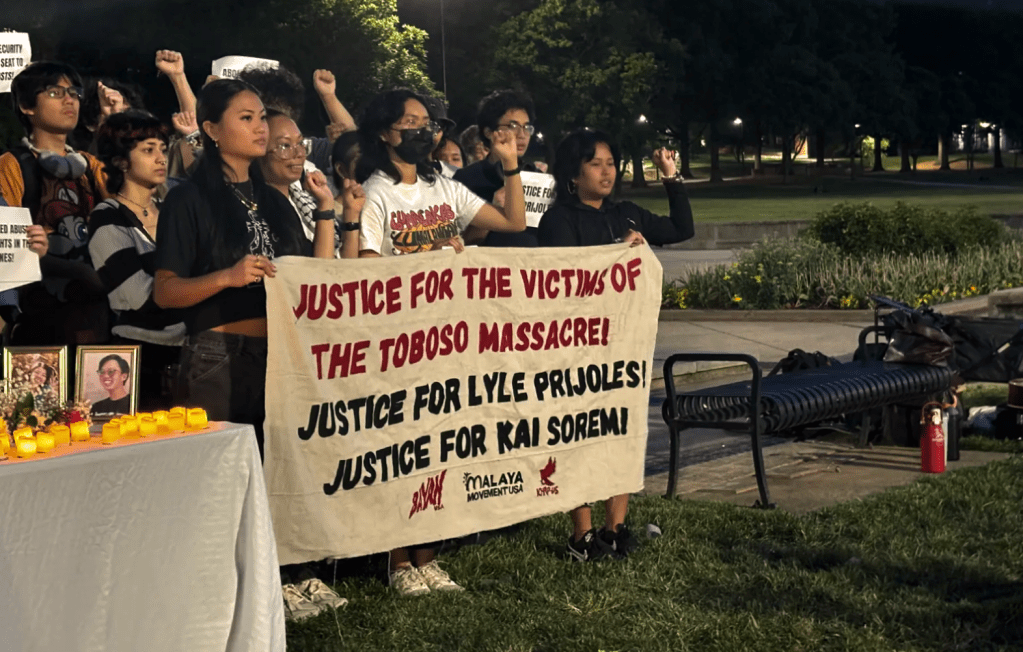
As candles flickered in front of framed photos, around two dozen students and community members gathered for a vigil on the evening of Tuesday, May 5, 2026 in McKeldin Mall to commemorate victims of the Toboso massacre in April.
“The Negros 19 massacre was not an isolated event nor an accident. It is a product of a fascist Philippine state that would rather protect the interest of the elite over solving the struggles that the majority of Filipino people are experiencing,” said Rio Gutierrez, a senior public health major and a member of Anakbayan College Park.
On April 19, 2026, the Armed Forces of the Philippines (AFP) launched an operation on the island of Negros, leading to hours of clashes and hundreds of civilians being displaced. The massacre occurred when the 79th Infantry Battalion of the Philippine Army killed 19 people during the operation, — including two U.S. citizens, Kai Dana-Rene Sorem and Lyle Prijoles — and 17 others including university students, human rights researchers, and journalists.
The AFP stated the killings were a legitimate military operation targeting combatants, with 10 of the 19 believed to be members of the New People’s Army (NPA), the armed wing of the Communist Party of the Philippines (CPP) that condemns U.S. influence and aims to overthrow the Philippine government and establish a communist system.
Human rights groups are calling for investigation into the killings of the 19 individuals, sometimes referred to as the “Negros 19,” citing human rights abuses committed by the AFP and Philippine government under Ferdinand Marcos Jr.’s administration. According to the International Association of Democratic Lawyers (IADL), a non-governmental organization which consults with the United Nations, the killings may have violated international humanitarian law.
“This massacre of peasant leaders, student activists, journalists and human rights activists can never be justified. It is not justified to murder those who are simply serving the people,” said Nevan McMillian during his speech delivered at the vigil.
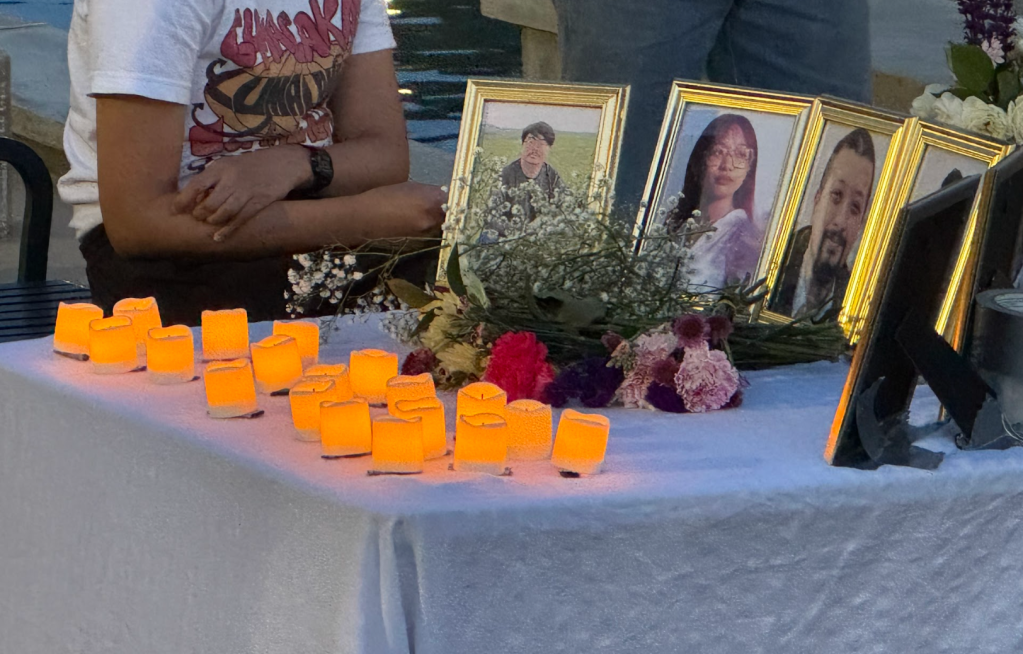
The vigil, which was co-hosted by the University of Maryland (UMD) student clubs Committee on Human Rights in the Philippines (TerpCHRP), Anakbayan College Park, and the Filipino Cultural Association (FCA), opened with student placing flowers symbolically in front of photos of the victims of the Toboso killings, followed by speeches from students, and a cultural music performance and art demonstration display. May 5 was designated by Philippine rights organizations as a Day of Mourning and Rage, with vigils and events held across the U.S. for the victims of the massacre.
Speakers hailed from several organizations, including TerpCHRP, Anakbayan, FCA, Students for Justice in Palestine (SJP), Young Democratic Socialists of America (YDSA) and the Asian American Student Union (AASU).
“Why is there so much violence by the hands of the AFP? It’s because corporations, including U.S. companies and the U.S. military, want to displace local populations, to export cheap labor, extract their resources and use the country as a launch pad and military base for our future war with China,” said McMillian, who is a member of TerpCHRP and a sophomore mechanical engineering major. “We must fight to get the U.S. out of the Philippines and get the U.S. out of everywhere.”
The Philippines, which was under Spanish colonial rule for over 330 years, did not achieve independence when the Spanish left in 1898 — the country was ceded to the United States until 1946.
Ownership of the Philippines was in the interests of the American elite due to the country’s location for trade with Asia, strategic naval positioning, and abundant natural resources. Under the U.S.’ rule, the Philippines was set up as a tariff-free import market for American goods, benefitting U.S. markets and suppressing Philippine industrialization — making the country increasingly dependent on American support, a dependence that still exists today.
U.S. rule in the Philippines was brutal, with up to 1 million Filipino people killed by American forces or by disease during the Philippine-American war for independence from 1899-1902, among various other crackdowns. The colony became a liability for the U.S. after the costly Philippine-American war and World War II, leading to the country’s independence in 1946.
But the legacy of American colonialism remains in the Philippines, according to Anakbayan USA and other organizations — in small part through Balikatan, annual joint military exercises with the U.S. and AFP, which this year took place the day after the massacre.
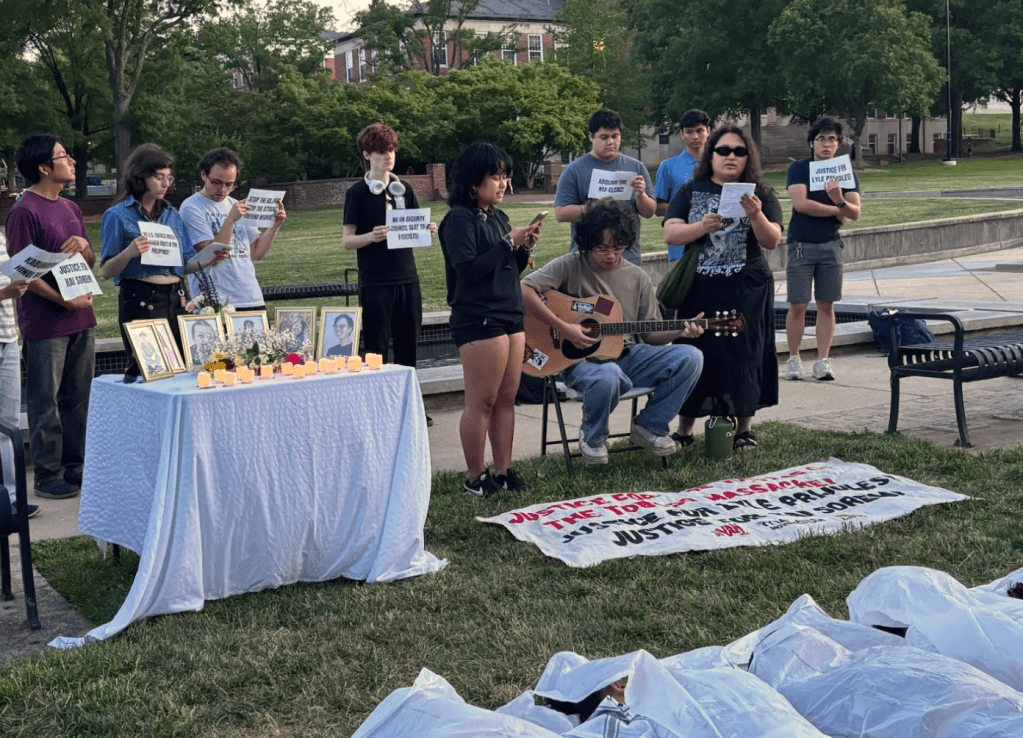
A common theme during speeches was that the same forces pulling the strings of corruption in the Philippine government also propel Israel’s genocide in Gaza and the brutality of the Immigration and Customs Enforcement (ICE) operations in the U.S.
Zyad Khan, a member of UMD SJP and a senior computer science major, said in his speech that there is a contradiction between this university’s words and actions — UMD “claims to stand for knowledge, for human dignity,” he said, yet they profit from weapons manufacturers who “suppl[y] the architecture of genocide from Gaza to Negros.”
It is widely regarded that the University System of Maryland (USM) has investments in arms-producing companies, with students across Maryland calling for divestment for a decade. Khan’s speech ended with chants for the USM to disclose investment holdings and divest from weapons manufacturers.
“The slave-catching terrorist organization known as ICE has been deporting Filipino seafarers all the way back to the Philippines, even though the reason why they even left in the first place is because the United States is literally committing war crimes on my people,” Matthew De Leon, a member of UMD YDSA and freshman information science major, told Al-Hikmah.
De Leon also said that UMD has “absolutely not” done enough to address its role in the broader military-industrial complex and that “they can absolutely divest.”
“I wish that one of the administrators could actually come and have an open mind and just listen to what we have to say, because what’s going on over back at home is real. It’s impacting everyone, including my family,” he said. “[UMD is] not even trying to do the bare minimum. They’re so entrenched with putting corporate power over people power that they would rather leave my people to die.”
McMillian said in his speech that there’s a “youth pipeline” encouraging students to pursue careers with weapons manufacturers.
“We’re not even safe from militarization here at UMD. Lockheed Martin is the world’s largest military contractor that sells their aircraft and bombs to the AFP, so why do I see that Lockheed Martin has dedicated rooms on campus?” he said. “UMD needs to end this pipeline, funneling their students towards the military-industrial complex, wasting our four year degrees that should be helping people which instead are used for exploiting and killing the innocent.”
Student organizers need to keep fighting against all imperialism from Palestine to Congo to the Philippines, and they will, De Leon told Al-Hikmah.
“We still haven’t dealt with the sins that the United States has done to the Native American people,” De Leon said. “We are not mad enough. We are not involved enough.”
After the speeches and musical performance had finished, Prijoles’ friend who attended the event briefly spoke, donning a shirt given to him by Prijoles with the words “serve the people” printed across the front.
“Serve the people … it was something that Lyle really lived by and died by,” he said with tears in his eyes. “If you want to uplift the 19 folks that have died and all the victims in the Philippines, try living by this model, serve the people, try to prioritize others before yourself. And it really will. It’s a fitting way to uphold the memories of these folks.”
To Filipino students at this university, Gutierrez has one message: “Go home and serve the people. You should see firsthand what our people are experiencing. You should see firsthand how they are being oppressed by their own government. And this will, in turn, move us forward into revolution.”
This story will be updated.
Image credits: Cover photo by Riona Sheikh for Al-Hikmah.


Leave a Reply