
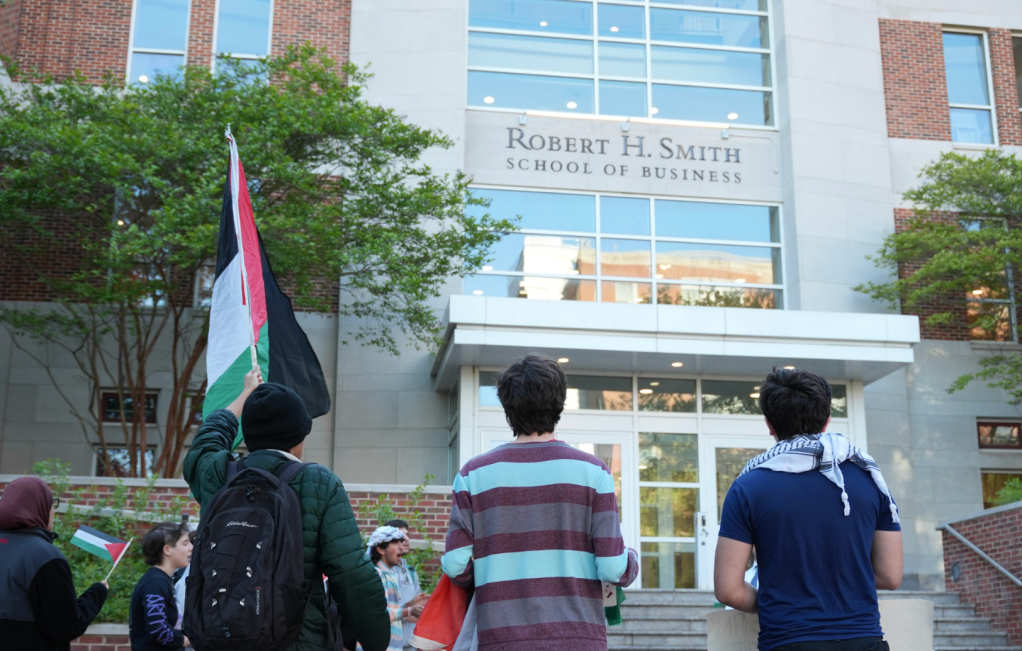
A Palestinian flag caught the wind, waving in the air as protestors chanted, “No normalization, we demand liberation” outside the Robert H. Smith School of Business on the evening of Tuesday, April 21 in opposition to a panel event held by the school featuring various speakers to discuss how to promote dialogue, with a secondary focus on Israel and Palestine.
The event, titled “Working Across the Divide,” was held in collaboration between the Smith school’s Ed Snider Center for Enterprise’s Fact-Based Discourse Initiative, the Arthur Vining Davis Foundation, the Campus Community Network, and BridgeUMD.
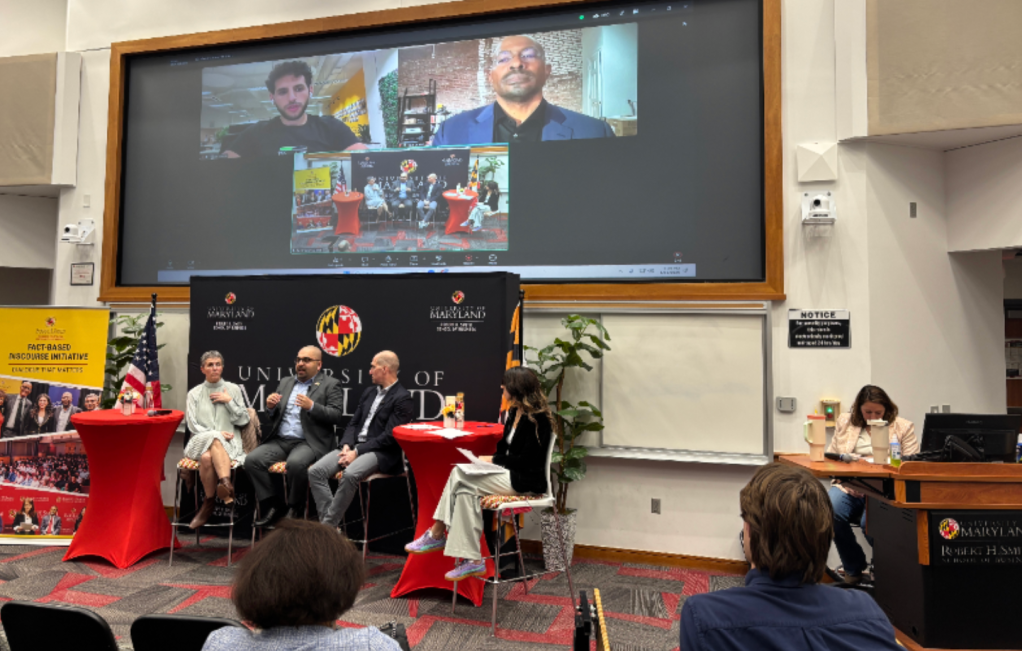
The panel gathered around 150 attendees and was moderated by Rellie Derfler-Rozin, a professor at the Smith School of Business, and organized largely by founding director of the Ed Snider center Rajshree Agarwal who also attended the event. Derfler-Rozin has previously signed the “Scholars for Truth About Genocide” letter that denies Israel’s commiting of genocide in Gaza and states Hamas committed genocide on Oct. 7, 2023. Derfler-Rozin is also a part of Faculty Against Antisemitism and for Freedom of Speech at this university.
“This event was about Palestinians and Israelis, and we try to bring events that are promoting dialogue against extremism,” Derfler-Rozin said. “If you are vouching for violence, it’s extreme. If you’re trying to force other people. Terror is extreme. All of those people are extreme. We don’t want to go to either extreme, and we want to elevate moderate people.”
Jacqueline Manger, the managing director for the Ed Snider center, said the event’s purpose was to promote dialogue and encourage students to challenge their own assumptions and talk to people who have a different perspective than them.
“’I’ve had a very fascinating discussion with some of the SJP members down here [who] are like, ‘but really, you’re platforming evil’ … they believe that we are platforming a group of people who are pro and back the genocide against their people,” she said. “I don’t know that I agree with that statement. What I do know is that the people that we attempt to bring here to talk are people that are not going to advocate for certain people not being allowed in the room.”
UMD Students for Justice in Palestine (SJP) said in an Instagram post that the speakers at the event “buil[t] careers normalizing occupation, genocide, and apartheid” and that the group “demand[s] an end to the campaign of zionist normalization on our campus.”
The panel’s speakers included Ahmed Fouad Alkhatib, a fellow at the Atlantic Council and director of Realign for Palestine, vlogger Nuseir “Nas Daily” Yassin, CNN Host Van Jones, Ilana Redstone, a sociology professor at the University of Illinois, Urbana-Champaign (UIUC) and Simon Greer, founder of Bridging the Gap and former CEO of Jewish Funds for Justice.
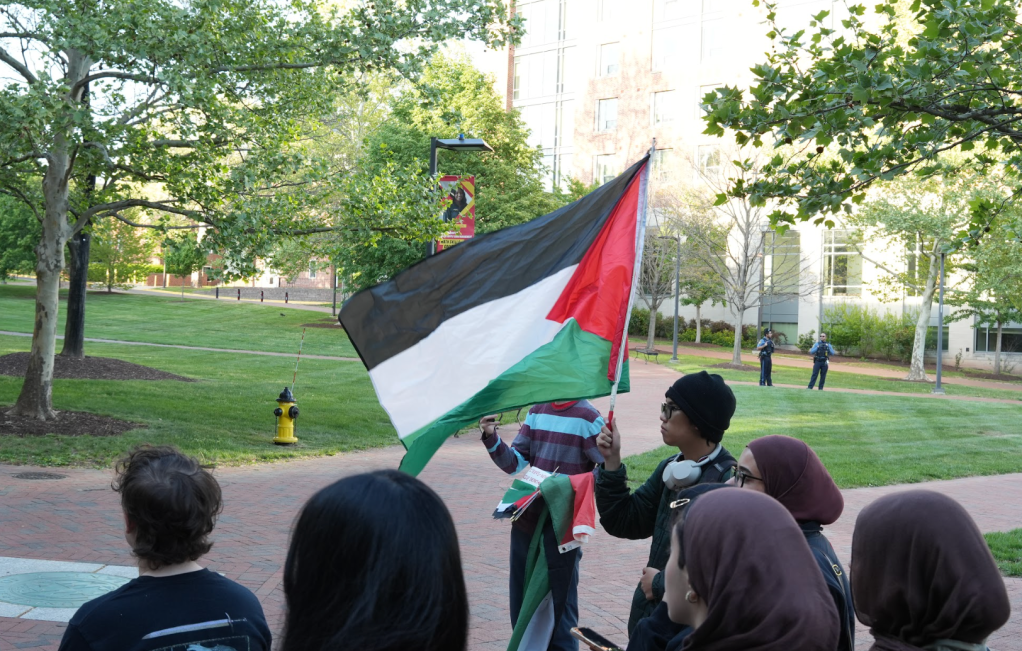
At the rally outside, UMD SJP member Mohammad Abukhdeir delivered a speech.
“They go out of their way to pay welcome and invite people that oppose Palestinian liberation and humanity under the guise of a so-called courageous conversation to foster understanding,” Abukhdeir said. “How useful is this dialogue with people who are actively helping bomb Gaza, to the children in tented schools targeted and shot in front of their classmates, to the families who are being starved to death time and time again?”
Mahtab Hasani, a junior finance major who is from Afghanistan with family in Iran, said the Smith school’s event was “highly disappointing.”
“I’m here to show my support for Palestinian people, but also on top of that, I feel a deeper empathy towards them because I went through the same experiences. I lost a lot of family members in the war [in Afghanistan] and currently, my family in Iran, I can’t get ahold of them. I don’t know if they’re alive or not,” she told Al-Hikmah. “All this ties back to Israel. So having these [Zionists] here speaking at the school that I get education from, it’s just disgusting.”
Abukhdeir said this university and the Smith Business School do not understand the genocide.
“They’re trying to bridge gaps between different people because they don’t see Palestinians as human. To them, this is just some foreign war. It’s an issue that they have nothing to do with, that they’re not complicit in,” he said in his speech. “They just want to benefit from it and make themselves look good as saviors by bringing together people who disagree, when those people are literally murderers.”
Nevan McMillian, a member of UMD’s Committee on Human Rights in the Philippines (TerpCHRP), said during the rally that “there is no centrist position in this. The extremist position is supporting genocide. The correct position is fighting for liberation.” The event wants students to “normalize genocide [because] it normalizes [other] acts of aggression throughout the world,” he said.
Abukhdeir, who is Palestinian, said some of the speakers “serv[e] as token Arabs, shamefully and disgustingly exploiting their own identities.”
Alkhatib, who lived in Gaza until he was 15 and lost hearing in one ear due to an Israeli airstrike, and Yassin, the Harvard-educated vlogger who grew up in Israel and identifies as “Palestinian-Israeli,” are of Palestinian Arab heritage. Yet their viewpoints didn’t align with protestors outside.
“Resistance sloganeering [says] there has to be truth and reconciliation in which millions of Palestinian refugees are repatriated and right of return and river to the sea in one binational state just like South Africa and blah, blah, blah,” Alkhatib said during the panel. “And I say no, guys, Israel and Palestine is very different.”
Alkhatib said there is a “total disconnect” between the “pro-Palestine community, including our lovely little protestors outside, versus the people in Gaza … Do you know how deeply hated Hamas is in Gaza?” According to Alkhatib, “Hamas handed the Palestinian people on a silver platter to the most far right and extremist government in Israel’s history.”
Yassin said that he fully agreed with Alkhatib’s take on the matter, and that many Israelis and Jewish-Americans rarely meet Arabs or Palestinians who “[do] not want their destruction.” Viewpoints like Alkhatib’s show that “maybe not all Palestinians want the death of [Israelis and Jewish people],” he said.
“And when you see a Nas Daily video, you think, okay, maybe not all Arabs are bad,” he added.
After the panel, Alkhatib told Al-Hikmah that protestors “should have been in here, being part of the conversion and engaging … rather than being presumptuous about what the speakers were going to say and who the speakers are.” The protesters “posture from this position of moral supremacy” which Alkhatib finds “very, very troubling.”
Gesturing at a student donned in a Palestinian jersey who moments before told Alkhatib he belongs in a “hall of shame” and asked him how he sleeps at night, Alkhatib told Al-Hikmah “this kind of attitude, for example, is disgusting. Who is this individual? They look ridiculous, right? Coming in here, doing these schemes, attempting to disrupt. It’s embarrassing, honestly.”
“There are those who want to make a point, and there are those who want to make a difference. And what I am promoting for myself is I want to make a difference,” Alkhatib said. “I don’t want to yell and scream. I don’t want to wear memorabilia and wear symbolisms and sloganeering around my neck and over my head and around my waist to virtue-signal. This [dialogue], to me, is so much more valuable than simply being reduced to a piece of cloth that you can wrap on your head to signal that I am the real advocate,” he said, gesturing at a student wearing a keffiyeh around their head.
CNN host Van Jones who joined the panel via Zoom said that oftentimes when discussing controversial topics, students are not thinking properly.
“I have a big concern that we’re not grounding enough of these conversations in the actual desperate work that needs to be done. I love it when you talk about your family getting killed in Palestine. You know, that’s real shit,” he said during the panel. “I’m just concerned that sometimes the students might be listening to this and they’re thinking about it from the wrong part of their brain. You got to think about it from your guts.”
Late Tuesday night, Alkhatib posted on X about the event. “Students for Jihad in Palestine (SJP) accused the speakers on this panel of ‘normalizing genocide,’” his post reads. “It is long past time for those who promote harmful, dehumanizing rhetoric and celebrate terrorism and Jihadi violence to be challenged, held accountable, and prevented from dominating public spaces with intimidation … say no to anti-American, anti-human, Jihadi-inspired militias and thugs on university campuses.”
Derfler-Rozin shared a similar sentiment as Alkhatib. “[They are] just shouting slogans as opposed to promoting solutions,” she said.
Upon request for a statement from Al-Hikmah, this university forwarded a public statement from Smith School’s Office of Marketing Communications.
“Freedom of thought and expression remain central to our academic mission. As a community of scholars and learners, we are committed to fostering open, rigorous, and constructive dialogue across a wide range of perspectives,” the statement reads. “We thank all of our panelists.”
Image credits: Cover photo by Hamza Muhib for Al-Hikmah.
 Al-Hikmah
Leave a comment