By Timnit Rwakaara
Since 2007, the University of Maryland at College Park has hosted an Arabic Flagship program, a federally funded initiative for students in the Arabic major or minor to gain advanced proficiency in the language. But starting Fall 2025, the program was no longer offered at UMD, leaving many students wondering what direction the Arabic department will go in.
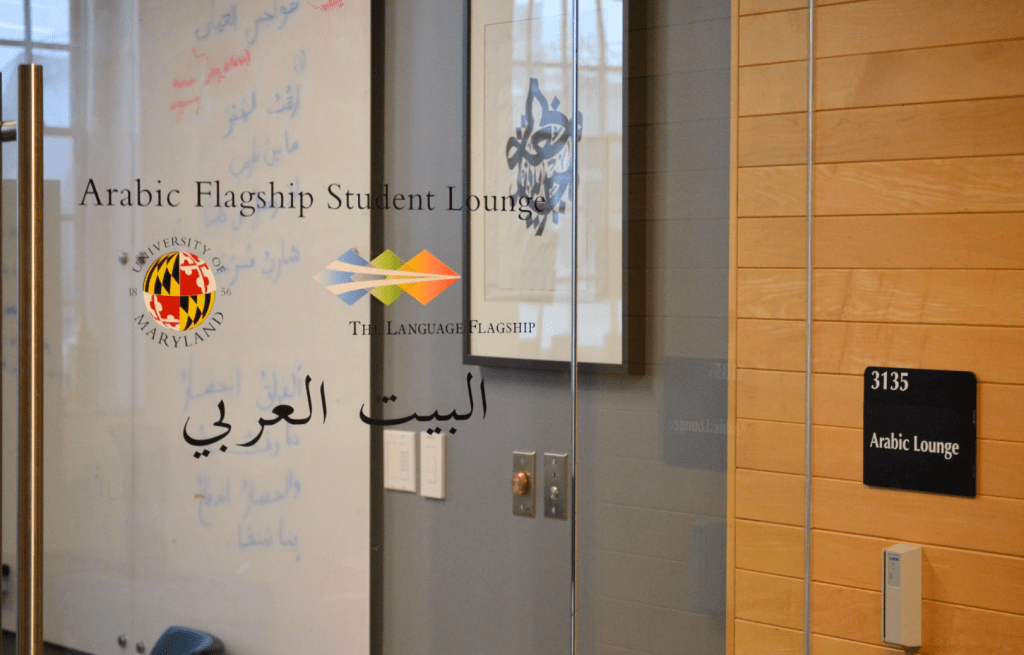
The program offered scholarships to study Arabic overseas in Morocco over the summer and funded initiatives that included specialized language tutors, a program coordinator who assisted Flagship students in their journey, and a Flagship lounge for students to network and study.
The university attributed the program closure to government funding cuts, similar to hundreds of other programs around the country. Dr. Anny Gaul, head of UMD’s Arabic department, said the decision came from Congress and included larger cuts.
“There had been six Arabic flagship programs at different universities, and they cut it to three,” she said. “Why those three? I don’t know how that decision was made.”
As federal priorities shift, this announcement left many students unsure about the future of Arabic education at UMD and questioning what opportunities will replace what the Flagship program once offered.
Mohamed Kamara, a junior Spanish major who participated in the Arabic Flagship program, said the Arabic Department now lacks support for Arabic students and that he may have to learn Arabic on his own after college. He also cited a loss of funding as a main factor driving him to reconsider language study.
“I don’t have as much support as before, and [I’m] not gonna have funding. So I definitely want to learn Arabic, but I’m gonna slow down,” he said. “I’ll just learn it on my own time, maybe after college or something.”
Although there is no longer a centralized Flagship program, there are still a multitude of opportunities for those hoping to study Arabic including the Critical Language Scholarship, Boren and Gilman Scholarships, UMD-in-Amman, and various external programs. Gaul said that the core strengths of the program remain and will continue to remain, although she noted that initiatives and programs may be less consolidated.
“Not all Arabic majors or minors did Flagship… we had many students who went through our program and studied the same classes that Flagship students studied and ended up with advanced proficiency.” Gaul also noted that the department recently reorganized the major, making requirements more flexible and easy to meet.
Gaul also said the curriculum and faculty “are the same as they were before Flagship.” Arabic faculty have been actively connecting students with resources: “We’re doing these class visits to make sure that Arabic students know who the faculty and administrators are, how we can help them, who to turn to for specific resources.” said Gaul.
A major development for the department is the new ‘Maryland-in-Amman’ program, officially launching in the Spring 2026 semester. Dr. Gaul credits Ustaadh Ahmed Hanafy for “taking the lead” and organizing the program for Arabic students.
The new program allows students to study in Jordan for a semester or summer and builds on a relationship already established with the host program, CET. “We know that the host institution’s curriculum works well with ours, and we’ve had students study there in the past,” Gaul said.
Shamai Frenkel, an international relations and Arabic double major set to participate in the program in spring expressed excitement and optimism about his upcoming trip.
Though Frenkel did not participate in the Arabic Flagship program, he said he was disappointed to learn it was ending. “I think it could have given me an excellent network,” he said.
Still, he believes the new UMD in Amman program fills an important gap. “I’m very excited for it … I think the UMD Arabic program in general is a really strong program.”
He also praised the program’s preparation and transparency. Students receive safety briefings, cultural-norm modules, frequent updates, and testimony from former students. “It would be almost impossible for you to go without having a good sense of what to expect,” he said. “I feel very looked after.”
Despite the loss of federal funding, Dr. Gaul is optimistic about the future of the Arabic department.
“I really am invested in building structures that will last regardless of funding” she explained, and elaborated on how Arabic faculty aim to build a community, and not just provide opportunities. She added that her goal is to make the Arabic major and minor “as accessible as possible”.
“I think if we organize that as a community, then the structures that we create won’t be dependent on federal funding to sustain them.” Dr. Gaul said.
Image credits: Cover photo by Shubh Agnihotri/Al-Hikmah.
 Al-Hikmah
Leave a reply to Link Roundup – 10 December – United Academics of Maryland-University of Maryland (UAM-UMD) Cancel reply