
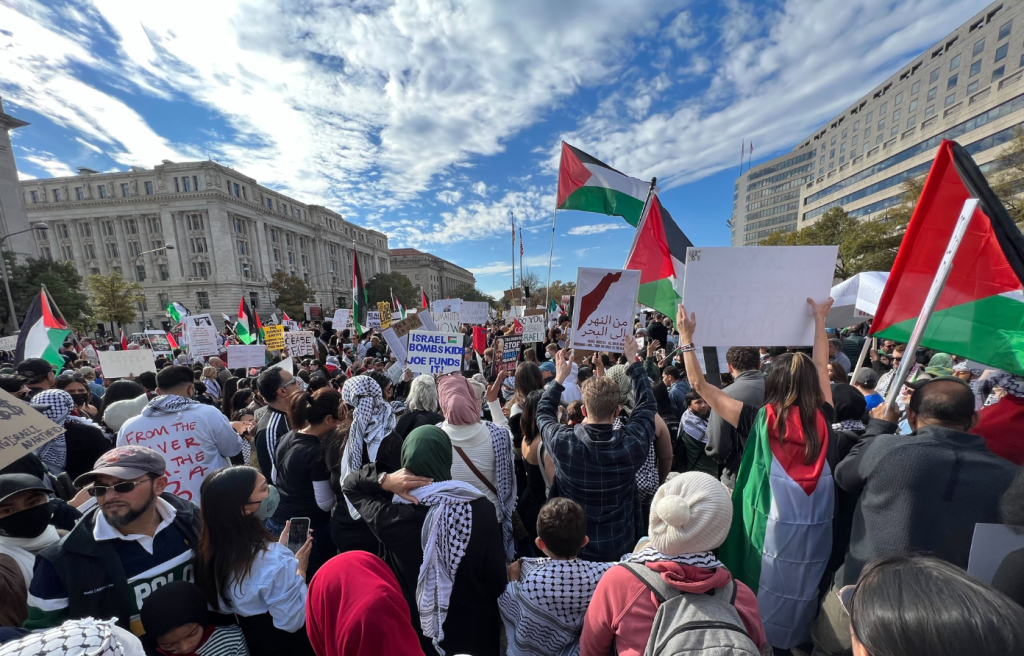
Israel’s offensive in Gaza has killed at least 46,600 Palestinians, over half of whom are women, children, and the elderly, over the past 15 months.
Sources such as the Yale School of Public Health suggest the true death toll may be higher. A conservative estimate from The Lancet, a medical journal, indicates that over 186,000 Palestinians died directly or indirectly due to Israeli attacks, starvation, disease, and other consequences of occupation and war.
This devastating conflict has reignited global protests against the prolonged Israeli assault on Gaza and the settler colonial ideology of Zionism.
Zionism: Origins and Intentions
Zionism is a form of Jewish nationalism that originated in 19th-century Europe, driven by rising antisemitism and persecution. Zionist leaders sought to establish a majority Jewish state in Palestine, a land predominantly inhabited by Palestinians.
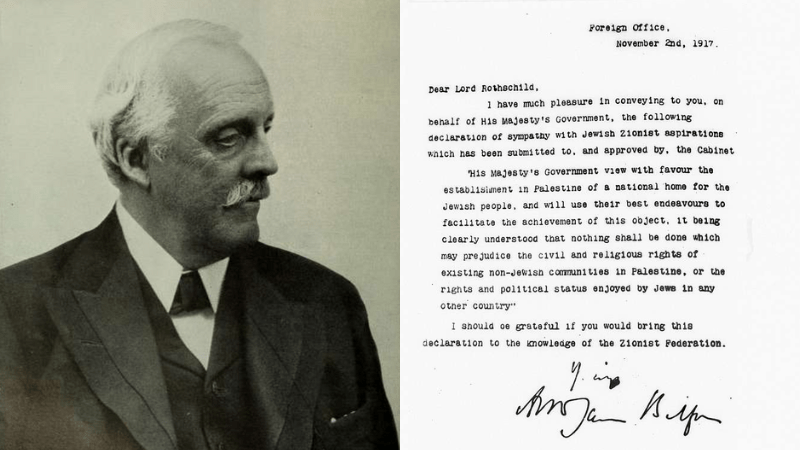
Portrait of Arthur Balfour, former Prime Minister of the UK, and The Balfour Declaration, a letter written from Balfour to British Zionist leader Lionel Walter Rothschild. Portrait from Internet Archive, used under PDM 1.0. Letter from Wikimedia Commons, sourced from British Library. Cropped from original. [Link to portrait. Link to letter.] License: PDM 1.0.
Zionist efforts gained momentum with British support, especially after the issuance of the Balfour Declaration in 1917. This declaration promised British support for a Jewish homeland in Palestine but was negotiated only with Zionist leaders like Chaim Weizmann without regard for the existing Palestinian population.
Palestinians, whose lands and future were being negotiated without their consent, were left disenfranchised by the growing Zionist movement.
The British Mandate and Colonization
During the Ottoman period, Jews, Christians, and Muslims coexisted in a system that promoted plurality and mutual tolerance. The increasing arrival of Jewish immigrants, coupled with the growing expulsion of Palestinians, heightened tensions. These conflicts were further fueled by existing anger towards Britain’s refusal to grant Arab statehood.
In 1900, Palestinians made up 94% of the population. However, due to significant Jewish migration, the Palestinians accounted for only 68% of the population in 1947.
After World War I, Britain assumed control of Palestine under the League of Nations Mandate. This marked the beginning of the British Mandate period (1922-1948) during which waves of Jewish immigrants arrived in Palestine.
These migrations were often accompanied by land acquisitions facilitated by Zionist organizations, such as the Jewish National Fund (JNF), which played a central role in displacing Palestinians. Land was purchased from absentee landlords for large sums of money, and the indigenous Palestinian farmers were subsequently expelled.
Between 1922, when the British mandate began, and 1948, the height of the Nakba—the Arabic word for catastrophe—, an estimated 100,000-150,000 Palestinians were forced to leave the lands they had cultivated for centuries.
The promises of Arab independence made during World War I by British officials, such as Henry McMahon, were abandoned completely when Britain and France carved up the Middle East through the Sykes-Picot Agreement.
The growing unrest culminated in the Arab Revolt and general strike of 1936-39. The revolt was violently suppressed by both the British and Zionist militias and severely weakened the general Palestinian population. Around 5,000 Palestinians are estimated to have been killed.
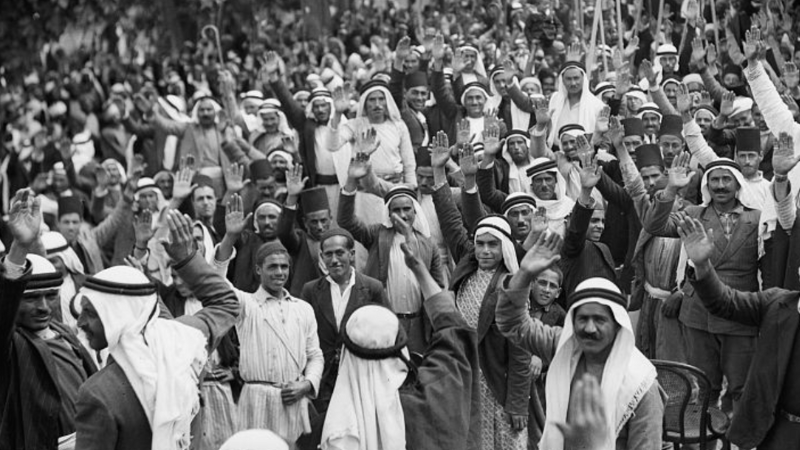
Palestinians at Abu Ghosh during the early stages of the 1936 Arab Revolt, taking the oath of allegiance to the Arab cause. Photo from Library of Congress.
Partition
Britain transferred this growing issue to the newly formed United Nations, which proposed dividing Palestine between Palestinians and Jews. For the Palestinians, the idea of partition was unthinkable and infringed on their right to self-determination and ownership of their land.
The main argument in support of the UN Partition Plan was to establish a Jewish state as a refuge for Jewish people after the Holocaust. Many Palestinians, however, argue that the atrocities committed against European Jews cannot justify the displacement and expulsion of Palestinians, who had no responsibility for the crimes of the Holocaust or the persecution of Jews in Europe.
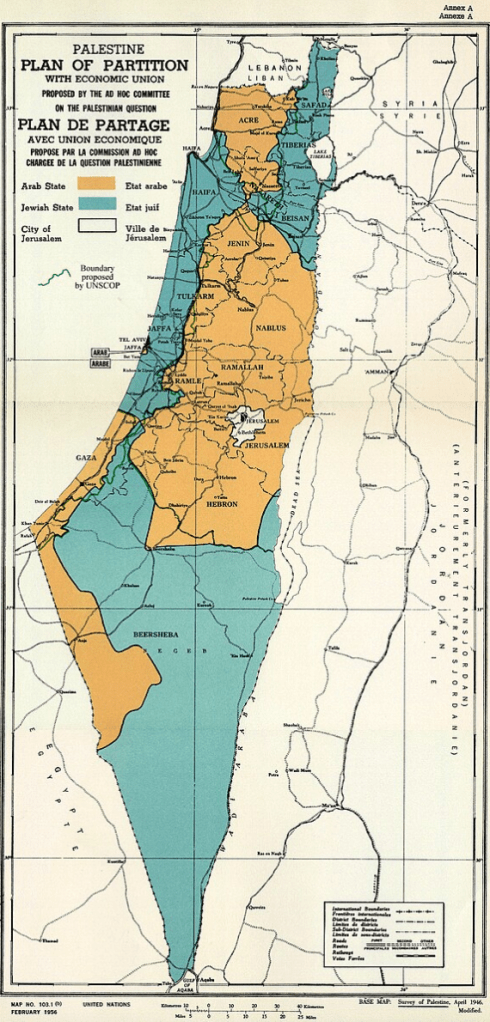
Despite Palestinians remaining a majority population, the 1947 UN Partition Plan allocated approximately 56% of Palestine to the Jewish population, which comprised less than a third of the population at the time. This would leave Palestinians with approximately 45% of the land.
Much of the land allocated to the Jewish population included fertile and strategically significant areas, such as coastal plains and parts of the Galilee. Palestinian leaders firmly rejected this plan.
Historian Ilan Pappe argues that David Ben-Gurion, the first prime minister of Israel, and other Zionist leaders saw the UN Partition Plan as an opportunity to expand territorial control across all of Palestine. Pappe cites Ben-Gurion as stating that the ultimate goal of Zionist leadership is “possession of the land as a whole”.
This vision aligned with Plan Dalet, a military strategy devised and adopted by Zionist leaders before the 1948 Arab-Israeli War. This plan called for the “destruction of villages through burning, demolition, and planting mines in rubble, especially in areas where Zionist forces faced resistance.”
According to right-wing Israeli historian Benny Morris, Plan Dalet served as “a strategic-ideological anchor and basis for expulsion.”
After the UN adopted the partition plan resolution on Nov. 29, 1947, violence between Jewish and Palestinian communities escalated even before the formal end of the British mandate on May 15, 1948.
Major episodes of violence began in February 1948, when Zionist militias began ethnically cleansing villages as the British withdrew.
The violence continued to intensify in the months leading up to the creation of Israel, with Zionist forces expelling Palestinians from the cities of Haifa, Jaffa, Safad, Beisan, Acre, and West Jerusalem. 250,000-300,000 Palestinians were expelled, marking the early stages of what would be known as the Nakba.
The Nakba
The Nakba, or “catastrophe,” refers to the period of mass expulsion, displacement, and violence against Palestinians that began after the adoption of the UN Partition Plan in 1947 and intensified into the forcible expulsion of approximately 750,000 Palestinians during and after the Arab-Israeli War of 1948–1949.
The ethnic cleansing and violence began months before the declaration of Israel’s statehood in 1948. Between November 1947 and mid-1948, Zionist militias launched a coordinated campaign of expulsions, aiming to secure as much territory as possible. Zionist forces had already expanded its control to 78% of historic Palestine, far beyond the partition borders originally proposed by the UN.
Arab states declared war in an attempt to resist the establishment of Israel. Historian Avi Shalim notes that the Arab forces were severely outnumbered and ill-armed, standing little chance against the British-trained and armed Zionist militias.
The Nakba is closely attributed to the objectives of Plan Dalet. In conjunction with the expulsions, Zionist militias destroyed nearly 500 villages and killed 15,000 Palestinians in several documented massacres, including the Deir Yassin massacre, prompting tens of thousands of people to flee their homes.
Zionist forces used brutal methods of expulsion, including detonating explosives in villages at night to instill fear among Palestinians. Palestinian historians, such as Walid Khalidi in his book “All that Remains”, have documented the process of systematic ethnic cleansing and violent expulsion that took place during the Nakba.
The Enduring Impact of the Nakba
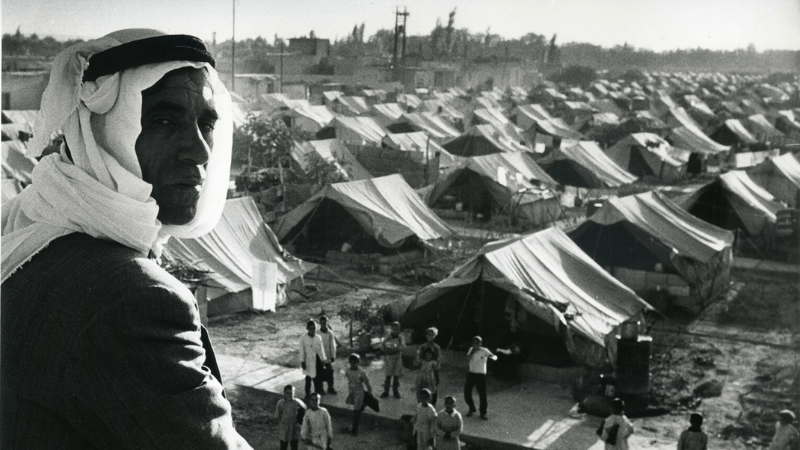
Image of a UNRWA-administered tented camp near Damascus, Syria, housing Palestinian refugees displaced by the 1967 Six-Day War. Photo by Jack Madvo, 1974. Courtesy of the Institute for Palestine Studies. [Link to original.] Public domain (Syria & U.S.).
Hundreds of thousands of Palestinians have been expelled from their homes in the years following the Nakba. Ethnic cleansing is widely understood as not only the violent removal of indigenous people from their homes but also the denial of their right to return. This right has been persistently denied to Palestinians who were displaced in the Nakba, and their descendants, many of whom remain in refugee camps and the diaspora to this day.
The legacy of the Nakba provides valuable context for understanding the ongoing violence in Gaza today. It is estimated that 80% of Gaza’s population descends from Palestinians who were displaced during the Nakba. Addressing ethnic cleansing and the right to return for refugees is crucial to achieving lasting peace and a just solution to the ongoing injustices faced by Palestinians today.
Map of UN Partition Plan: Original map sourced from UNGA Resolution 181, derived from Zero000 with UNSCOP partition boundary added. [Link to original.] License: CC BY-SA 3.0.

 Al-Hikmah


Leave a comment