

“O ye who believe! Fasting has been prescribed upon you as it was [the nations] past that you attain God-conciousness.”
Quran 2:183
Guy Fieri once remarked, “Food is maybe the only universal thing that has the power to really bring everyone together.” At a time when all we can notice is our differences, food reminds us no matter how many lines we draw, we are all more similar than we think. The necessity of food inevitably worms its way into every living culture as we mark our highest moments with our cuisine’s finest, whilst in our lowest moments we assuage our anxieties with food’s guilty pleasures.
No wonder it strikes many as odd when Muslims around the world suddenly draw another line — for a month, from dawn till dusk, none of this unifying, human pleasure is to be celebrated at all.
Many have tried to explain this unique tradition. Some posit empathy to the poor. Others view it as rejection of gluttony. But why do these values appear for only a month and disappear for the year’s remainder? Lost in practice and celebration of a holy month is how Islam cultivates its adherents’ relationship with hunger outside Ramadan. Islam’s early history can help explain the values placed within food for Muslims, and how that culminates in Ramadan.
A tradition of sacrifice

In the lore of Abrahamic religions, the sons of Adam alayhi wa sallam (AS) were called upon by God to offer a sacrifice. The Quran relates the story and doesn’t specify the material differences between the two brothers’ sacrifices. In the Ma’riful Qur’an, Mufti Muhammad Shafi writes that one brother’s sacrifice of a lamb was accepted with a wreath of fire descending from the heavens and consuming it, which is how Allah SWT indicated His Acceptance for sacrifices back then (Ma’riful Qur’an, Tafsir Jalalayn).
Fast forward a few millennia, and the Prophet Ibrahim (AS) is being plagued with strange dreams wherein he is slaughtering his son. After slaughtering camel after camel in sacrifice, he relents and informs his firstborn son, Ismail (AS), of the Divine Command. As both Prophet and son yield to the command of Allah, the blade suddenly becomes dull and fails to cut the neck of Ismail (AS). Thereafter, Allah SWT signals His happiness by instead sending a ram from Paradise to be slaughtered in the stead of Ismail (AS). So pleased was Allah SWT with this, that “… and we blessed Ibrahim with honorable mention among later generations” (Saffat 99).
From the beginning, offerings have always been a form of worship to Allah SWT. It is so important to our religion that of the two holidays we have, one — Eid al-Adha, during which Muslims sacrifice an animal — is dedicated to commemorating the level of sacrifice Ibrahim (AS) was prepared to do. And in the sight of Allah, from amongst the most precious of sacrifices is sustenance. The sacrifice of Habil, one of Adam’s (AS) sons, reflected his willingness to part with the best of his flock in order to please Allah whereas his brother was only willing to barter with Allah using grains. When satisfied with the obedience of Ibrahim (AS), Allah SWT ordered generations for thousands of years to mimic that same obedience, “…so pray to your Lord and slaughter.” (Kawthar 2, Tafsir ibn Kathir). When a child is born in Muslim households, an aqiqah takes place where the child’s parents sacrifice an animal and distribute the meat amongst the community. On Eid al-Adha, all Muslims able to do so replicate the same practice; sacrifice an animal, and give away the meat.
Thus, one facet of a Muslim’s relationship to food and hunger is sacrifice. When commanded to, are we willing to part with the very thing that keeps our hearts beating like Habil, or the children we hold dear like Ibrahim (AS)? Or will we jealously keep for ourselves the choicest of things whilst only sparing for another but a few cheap grains, like Qabil?
The Year of Tragedy
“And We shall certainly test you with a touch of fear and famine and loss of property, life, crops. Give glad tidings to those who are patient…”
Quran 2:155
Muslims suffered brutal persecution in Mecca. From stories of Bilal’s radiya-llahu anhum (RA) chest laden with rocks in the Arabian desert to Sumaya (RA) having a spear driven through her in front of her family, Muslims are no stranger to violence. The Year of Tragedy marks a particular period of the Prophet Muhammad’s (peace be upon him) life so stained with grief it makes much of his other suffering pale in comparison.
Around 615-616 CE, the Quraysh began the boycott of Banu Hashim, the Prophet’s (PBUH) clan within the Quraysh tribe.
Today, boycotts tend to be strictly economic and don’t always incorporate social components. This boycott was holistic. All social, marital, political, and economic resources which might be directed to Banu Hashim, the Prophet’s tribe, were to be cut off completely. Merchants coming into Mecca would be offered exorbitant prices for their goods, making it impossible for the Companions to buy anything for a reasonable price. Banu Hashim was driven out of Mecca into a small ravine owned by Abu Talib, the Prophet’s (PBUH) uncle.. So little food was present that families would boil leaves from trees in water and eat them. Save for a few kindhearted Meccans who went out of their way to evade the boycott and deliver goods, almost no resources were delivered to the valley. The boycott only terminated due to a miracle where the Quraysh found the restrictive document consumed and torn by ants save for the portion with Allah’s SWT name. The boycott formally ended in 619 CE, around the 10th year of Prophethood.
This joy, however, was short lived.
Soon, Abu Talib was on his deathbed. The Prophet (PBUH) found his uncle surrounded by Qurayshi elites. In one short breath, the Prophet’s SAW greatest ally was gone and with him, the tribal protection he’d had. Not long after Abu Talib’s death, Khadija bint Khuwailid (RA), the Prophet’s (PBUH) first wife passed away due to the weakness caused by the severity of the boycott.
The Prophet’s (PBUH) early years of preaching were marked by countless losses. Yet few losses amount to what was taken from him when food changed from a basic need to a weapon. Throughout our Sunnah are countless narrations that discuss being thankful for food, not wasting it, and sacrificing it for others. As Muslims remember these words and the Prophet’s (PBUH) tragedy, a new element takes root in our relationship with food: violence. For baked into our history are the losses suffered at the hands of the cruel wielding our needs against us.
The wheel of time
Mark Twain once said, “History doesn’t repeat itself, but it often rhymes.” The Prophet (PBUH) himself suggested something similar when he said, “Islam began as something strange and will go back to being strange, so glad-tidings to the strangers” (Ibn Majah 3986). As it relates to food, what parts of history are beginning to rhyme with the present?
As of 2025, Amnesty International reports that the genocide of Uyghur Muslims in China has shown no signs of stopping. Amongst the numerous human rights violations committed by the Chinese Communist Party (CCP) are, According to a Human Rights Watch (HRW) report from 2021, the Chinese Communist Party (CCP) has committed numerous human rights violations, including “deprivation of food and water arbitrarily inflicted on detainees [of the reeducation camps]” and “reports of government officials pressuring Turkic Muslims into drinking alcohol, in violation of their religious beliefs.”
Also in 2025, the United Nations (UN) reported on the active genocide of Rohingya people, who are primarily Muslim. The 2021 coup has led to “forced recruitment, sexual violence, airstrikes, starvation and mass displacement,” according to the UN. With resources running out, refugees are left malnourished and pushing more people into taking dangerous sea journeys.”
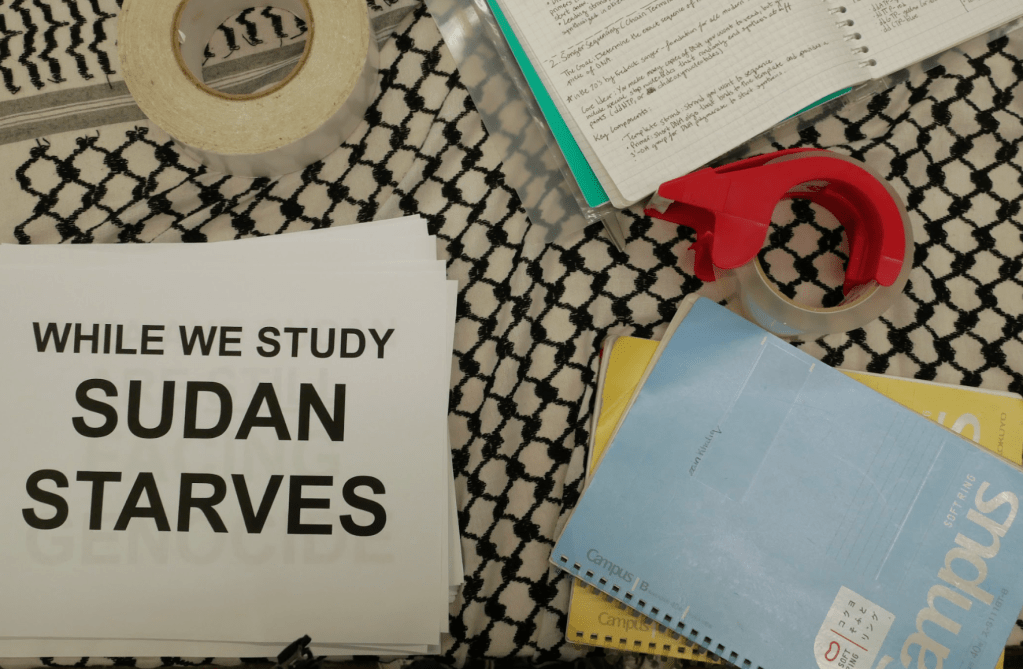
As of February 2026, Sudan will have passed 1000 days of continuous, relentless civil war. This has directly led to, according to the UN’s World Food Programme (WFP), “the world’s largest hunger crisis,” with an estimated 21+ million people all facing life threatening food insecurity. To make matters worse, also in Feb. 2026, the UN reported that famine has spread, “…in locations not previously considered at risk, such as Um Baru and Kernoi.”
In Gaza, reporting by Al-Jazeera shows a history of Israel weaponizing starvation and using it as a tool of war in the region, with the UN reporting in January that although famine was averted at the last second, the situation remains “ extremely precarious and deadly for many children” with at least 100,000 children acutely malnourished and in desperate need of food.
These are just a few of the stories of those starving around the world, forced to beg for basic human necessities. This is not a recent occurrence, but a practice which rhymes with our history time and time again. For many on the East Coast, this Ramadan marks some of the shortest fasts ever observed in our short lifetimes, but for those few hours, we connect with our history of hunger. We feel a shadow of the pangs a Rohingya refugee feels everyday. We know an ounce of weakness present in the bones of a Gazan child. What sets us apart is that when dusk sets, our hunger has meaning as the wait somehow makes the food taste even better. Around the world, however, hundreds of thousands of Muslims had nothing with which to break their fasts. A forced, imposed, and evil fast designed to break them for little more than the faith they choose to abide by.
As the wheels of time turn, those good, few Meccans who fought righteously have their chance to rhyme with the present. The International Court of Justice (ICJ) has finally begun proceedings against the reigning government in Myanmar to determine its complicity in crimes against humanity committed against the Rohingya. Though incredibly slow and far below what’s needed, aid has been moving into Gaza, with the British Red Cross reporting that the Egyptian Red Crescent Society has been handling approximately 400 trucks of aid to Gaza since Nov. 2025. Moreover, public awareness of these issues has been growing steadily, with support for the plight of the Palestinians reaching as high as 60% in the US just last year.
Violence, sacrifice, and fasting
You’d be forgiven for thinking the Year of Tragedy was the end of the Muslims. Expelled from their home, their strongest supports withered, and barely a few hundred left when all is said and done. Yet that’s not where the story ends. Allah SWT made a promise: “Verily we’ve conquered for you a great conquest” (Fath 1). This promise came true when Mecca fell to the Prophet Muhammad (PBUH) after he led an army into Mecca, laying claim to the city without shedding so much as a drop of blood. Though Abu Talib and Khadija (RA) weren’t there to witness the fruits of their labor bloom, the Year of Tragedy is but one year after which followed Islam’s Golden Age.
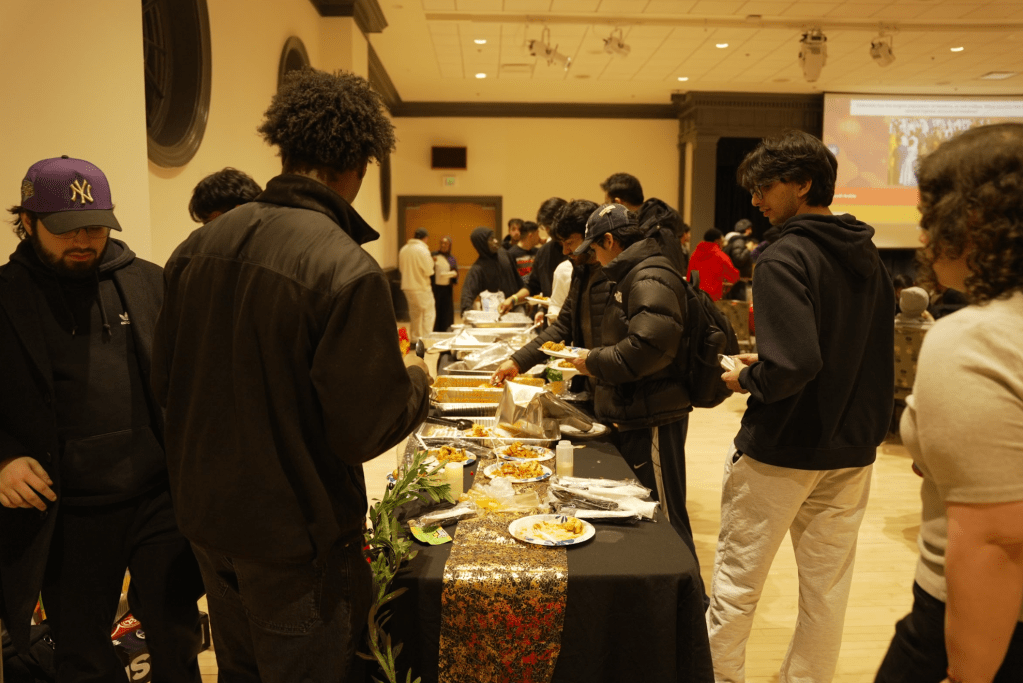
And every year, we go hungry for a month. We try to sit in the stead of our beloved Prophet (PBUH) as he had to watch his own family starve. We imagine the hopelessness with which many Muslims meet the setting sun as they are bereft of the food so elegantly placed before us. And somehow, Allah SWT promises that this is supposed to give us taqwa (God-consciousness). The thing about taqwa is that it could be anything! Any increase of Iman can be correlated to an increase in taqwa. This year, however, let us try to remember one particular Hadith:
“The best of you in faith is the one who is most excellent in character…”
Tirmidhi 1162
One measure of faith is being conscious of our brothers’ and sisters’ needs. This year, let the taqwa we attain be in recounting our history with the fast, be it in this month or outside of it — in remembering the countless times our forebears sacrificed their own sustenance to help someone else, and the countless instances of violence when they were made to go hungry. Because sacrifice and violence are our history, written over our tablespreads and molded into our silverware, baked into the very taste of the food we eat. Let our fast be a symbol of our undying memory of the all-at-once cruel, twisted, happy, sweet and sour bond between Islam and hunger.
Image credits: Cover photo by Safiyah Fatima.
 Al-Hikmah
Leave a comment