

Three soldiers from Israel’s military who fought in Gaza during the ongoing genocide were on UMD’s campus at an event held by student organization Students Supporting Israel (SSI) in Jimenez Hall on Tuesday, Oct. 21.
The event was intended for the soldiers — Ariel Levy, Daniel Shalom, and Avigayil Atlas — to share their “powerful stories” about serving in the Israeli military during Israel’s genocide on Gaza, according to UMD SSI’s Instagram.
UMD SSI is a campus chapter of the larger “pro-Israel international campus movement” of the same name, according to SSI Movement’s website. The international SSI Movement works with college campuses to hold different events, including an Israeli Defense Forces (IDF) soldiers tour called “Triggered: From Combat to Campus.”
In March 2025, two IDF soldiers who fought during the genocide visited UMD’s campus through an event held by UMD SSI and the SSI Movement. UMD SSI described the March event as a “super fun” and “once in a lifetime” opportunity to learn about the soldiers’ stories of “bravery, sacrifice, and hope for Zionism,” according to UMD SSI’s Instagram.
At least 50,000 Palestinian people, including 15,000 children, had been killed by Israel’s military by March 2025.
As of Oct. 7, 2025, at least 67,173 people have been killed by Israel in Gaza, including 18,430 children, according to the United Nations Office for the Coordination of Humanitarian Affairs. Medical journal The Lancet estimated in 2024 that at least 186,000 Palestinians had been killed by Israel, indirectly or directly by bombardments, disease, or starvation.
Sarah Edwan, a student whose family hails from Gaza, said she was shocked the University would allow the event.
“I’ve lost so much family [at] the hands of IDF soldiers, and then just bringing them to this campus and saying [it’s] for open dialogue,” said Edwan. “My family is being killed, and then they’re bringing their killers to this campus.”
The junior information science major said that bringing IDF soldiers on campus was a safety issue for “every single student” because of the crimes the soldiers have committed.
“It’s not safe to bring people that were killing innocent people to a campus,” she said.
Jenna Merish, a Palestinian student, said that though UMD administration has repeatedly shown that they don’t care about the Arab and Muslim community on campus, the event also shocked her.
“What are they going to talk about? Their times killing innocent children?” she said. “It should fundamentally make sense to people to not host war criminals and people who have committed genocide on our campus.”
Merish also said she feels unsafe because of the event.
“I know that they [the IDF soldiers] have [gone] and killed my people…as a Palestinian myself, I don’t know what would happen if we were to cross paths while we were on campus,” said the junior psychology major. “The fact that the university is just allowing this to happen and taking that risk and chance that we could maybe cross paths is just beyond me.”
University policy says that “threats of physical violence and unlawful harassment” are exceptions to First Amendment protected speech in campus facilities. A threat is defined by the University as “expression of intent to commit an act or acts of physical violence to a particular individual or group of individuals.”
IDF soldiers have repeatedly violated international law during the last two years, committing numerous war crimes and crimes against humanity against Palestinian people, according to the United Nations (UN). Israel faces a genocide case at the International Court of Justice. Many human rights groups, including Amnesty International, have found Israel and its military to have genocidal intent and documented soldiers using violent rhetoric towards Palestinians.
Students, student groups, and student organizations are prohibited from “intentionally or recklessly causing reasonable expectation of [physical] harm,” according to the UMD Code of Student Conduct.
In a statement to Al-Hikmah, the University stated that the event was “planned according to university policies” and that the event was “not university-sponsored.” UMD did not respond to Al-Hikmah’s questions about the specific policies listed above in reference to the SSI event.
“I think the university’s policies need to be stricter if they’re going to allow genocidal people to come and have a platform here,” said Edwan. “They need to put something in place to not allow this to happen again.”
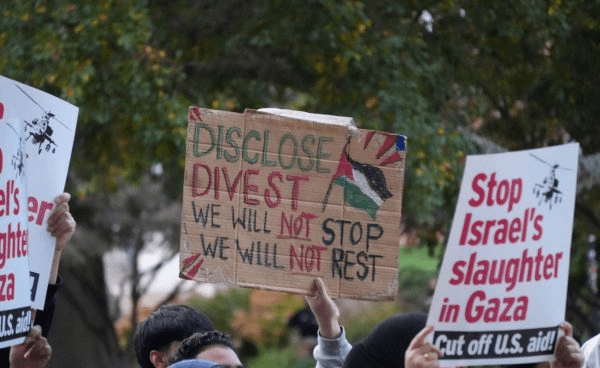
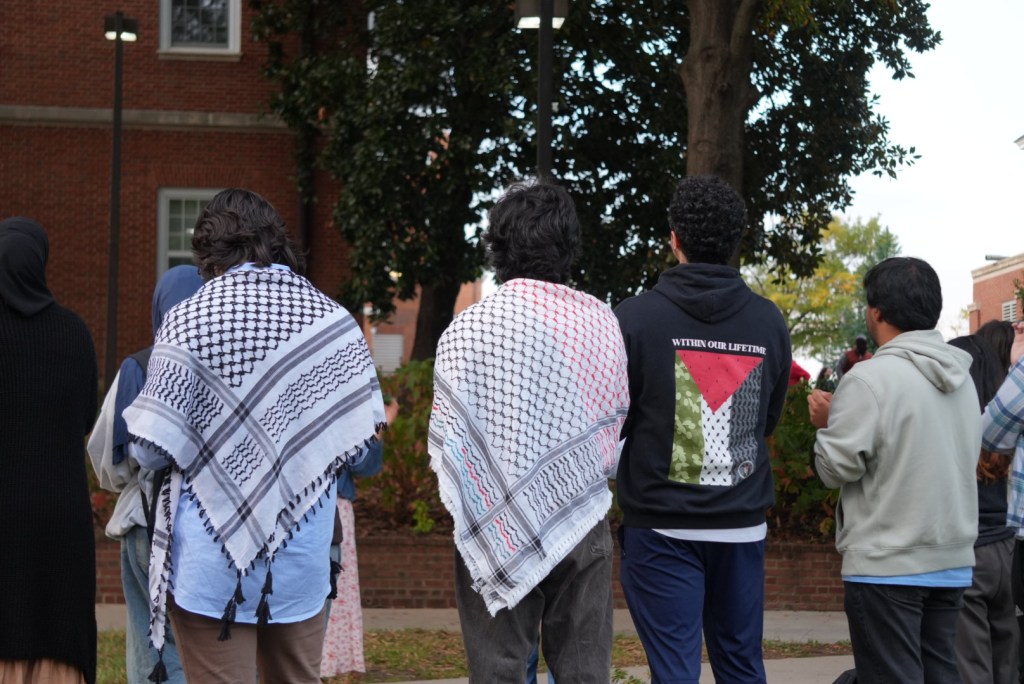
Dozens of students gathered in McKeldin Mall outside Jimenez Hall on Tuesday evening to protest the presence of IDF soldiers on campus. Protestors held signs, chanted, and listened to speeches for several hours.
“As somebody who comes from a Jewish background, [b]eing complicit [is] never okay, even if you’re raised in it,” said Beck Fishell, a protestor and senior anthropology and biology major.
Fishell called the event “baffling” and an “endorsement of genocide” and criticized UMD for not being proactive enough.
In a speech delivered at the protest, Edwan spoke about her family members killed by Israel during the ongoing genocide in Gaza.
“[My family members,] they were baking bread. They were killed by an Israeli airstrike, and so was my cousin,” Edwan said. “She was my age. She was also killed in her tents in July. And in that airstrike, they injured 40 members of my family, and to this day, they still have shrapnel in their lungs.”
“The university expects us to stay silent, smiling in the name of unity, but we cannot ignore the violence that took our family members’ lives funded by our institution’s investments.”
UMD repeatedly did not respond to Al-Hikmah’s questions about how Palestinian students would be protected in the presence of soldiers who committed genocide on their people.
The organization UMD SSI repeatedly did not respond to Al-Hikmah’s requests for comment.
UMD president Darryll Pines did not respond to Al-Hikmah’s request for comment.
Image credits: Cover photo by Amna Tariq.
 Al-Hikmah
Leave a comment