
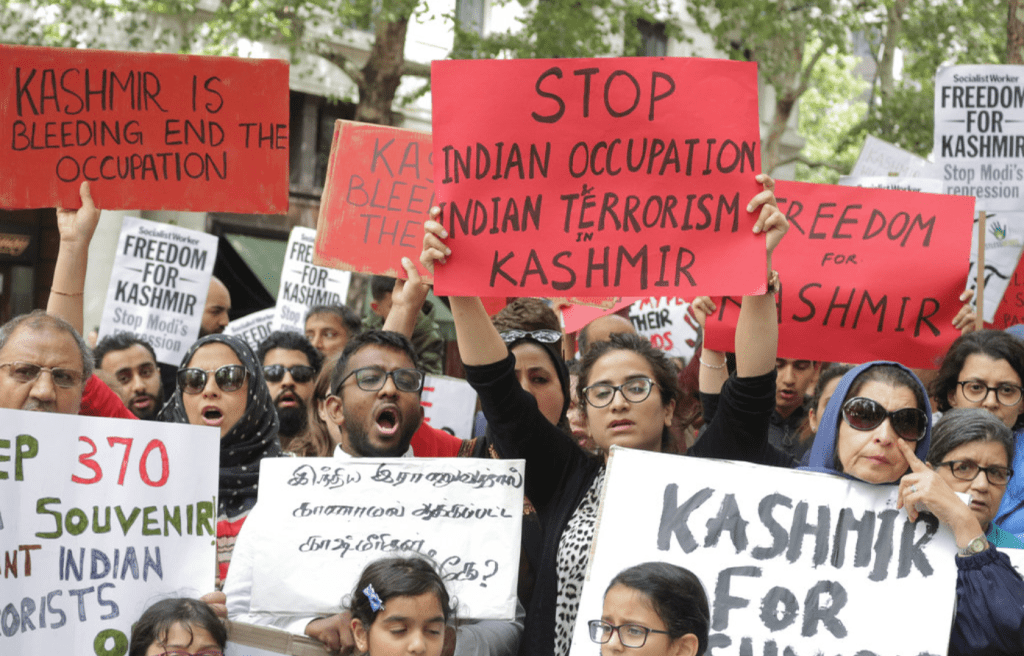
Kashmir, situated in the heart of the western Himalayas, has long been a region of immense geopolitical, cultural, and economic significance. Located at the crossroads of South Asia, Central Asia, and China, Kashmir holds a vital position due to its natural resources, including being home to some of the most important rivers in the region, which provide water to both India and Pakistan. Its location also offers military advantages, making it a focal point between the two nations, which consider the region crucial to their national interests.
Independence of India and Pakistan
The conflict over Kashmir dates back to the partition of India and Pakistan in August 1947, when Britain withdrew from the subcontinent.
Post-independence India was composed of princely states, including Jammu and Kashmir. The states were given the option to join either India or Pakistan, or remain independent.
While most states opted to join one of the countries, Jammu and Kashmir’s Maharaja, Hari Singh, a Hindu ruler of a predominantly Muslim population, initially chose to remain independent. This decision was influenced by the complex demographics of the region—Kashmir’s Muslim majority favored Pakistan, while the minority Hindu and Sikh populations feared persecution under Pakistani rule.
In September 1947, Pakistani militants seized much of western Kashmir when Singh refused to accede to Pakistan. The invasion led to widespread violence, resulting in significant Muslim casualties and escalating pro-Pakistan sentiment among Kashmiris.
The Instrument of Accession
The brutal invasion prompted Singh to seek military assistance from India. India agreed only on the condition that Jammu and Kashmir would accede to India.
On Oct. 26, 1947, Singh signed the Instrument of Accession, which formally bound Jammu and Kashmir to India. The document included a provision that once Kashmir was free of Pakistani militants, its people—not the Maharaja—would decide the region’s future. This “temporary accession” was later incorporated into India’s Constitution as Article 370, which became a key point of contention in the Kashmir dispute in the following years.
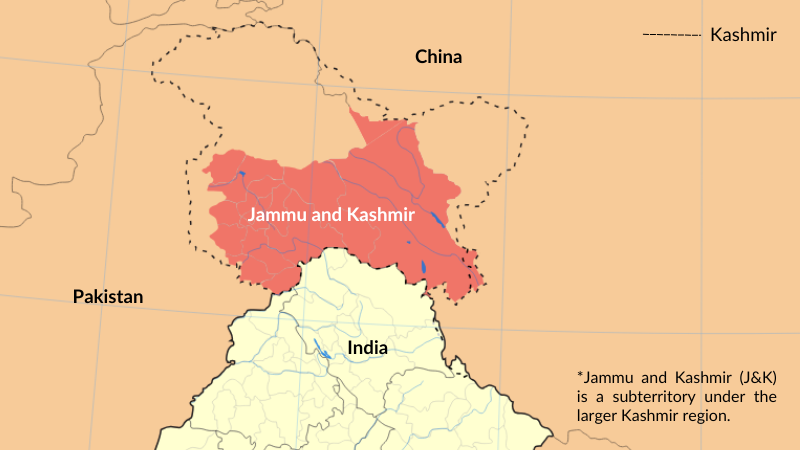
Map showing the territorial divisions of Kashmir. Labels added by Riona Sheikh. Original map by Planemad, derived from Soumya-8974, used under CC BY 3.0 / Cropped from original. [Link to original image.] License details: CC BY 3.0 License
The arrival of Indian troops led to the Indo-Pakistani War–also known as the First Kashmir War–which lasted until December 1948. The presence of Indian forces heightened tensions among the Kashmiri Muslim population, leading to growing resentment and divisions between communities.
Large-scale violence, including the Jammu massacres of 1947, erupted during the time of the war. Hindu and Sikh mobs killed tens of thousands of Muslims in Jammu. Up to half a million Muslims were estimated to have been displaced.
UN Involvement and Resolution 47
Unable to resolve the situation through direct negotiation, India and Pakistan turned to the United Nations for mediation.
On Apr. 21, 1948, the UN issued Resolution 47, calling for an immediate ceasefire and a plebiscite–a direct vote of the people–in Kashmir to determine whether the region would join Pakistan, India, or remain independent. Although a ceasefire was established in January 1949, both sides hesitated to withdraw their forces, fearing the other side’s non-compliance.
India was reluctant to allow a plebiscite, fearing the Muslim-majority population would vote to join Pakistan. Pakistan feared that the Kashmiris would choose independence. These concerns led to years of diplomatic gridlock, with both sides failing to agree on the terms of the plebiscite.
The Collapse of the Plebiscite Effort
By 1953, the political landscape of Kashmir had changed significantly.
After the overthrow of the Maharaja, a pro-plebiscite government took power in Kashmir–yet the possibility of a plebiscite seemed increasingly unlikely.
Under Article 370, which was largely implemented in 1953, the Indian government granted Jammu and Kashmir a special level of autonomy. This meant that Kashmir had its own constitution, a separate flag, and control over many of its internal affairs.
While Article 370 was initially seen as granting Kashmiris self-determination, its autonomy provisions were used as a tool to justify India’s control over Jammu and Kashmir, and the promised plebiscite was never held.
In August 1953, Indian Prime Minister Jawaharlal Nehru proposed a new agreement with Pakistan to conduct a plebiscite under the mediation of a weaker neutral power instead of the UN.
Pakistan accepted the proposal, but in 1954, when the U.S. announced military aid to Pakistan, India withdrew its offer, fearing a shift in the regional power balance, and the plebiscite never took place.
In the aftermath of the 1971 Indo-Pakistani war, India and Pakistan signed the Simla Agreement, which formalized the Line of Control (LoC) in Kashmir as the border between the two countries. Despite this, the central issue–India’s administration of Kashmir–remained unresolved.
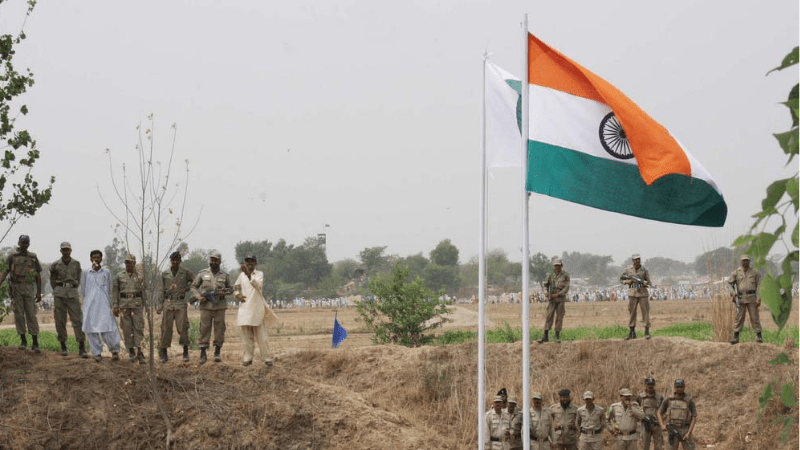
Border guards at the LoC in Kashmir, a region divided by decades of conflict. Photo by Vishal Dutta, used under CC BY 2.0 / Cropped from original. [Link to original image.] License details: CC BY 2.0 License
The Rise of Separatism in Kashmir
After the Simla Agreement, India’s constitution incorporated Article 35A under Article 370, granting special privileges to permanent residents of Jammu and Kashmir. However, this provision failed to satisfy Kashmir’s Muslim population, who continued to seek a plebiscite.
By 1975, Kashmir’s first elected government was put in office under the provisions of Article 370. According to Sheikh Abdullah’s autobiography, Flames of the Chinar, most candidates in the election did not represent Kashmiri’s call for a plebiscite.
The 1980s saw a rise in pro-Hindu rhetoric, fueling demands for central control over Kashmir. This reignited calls for a plebiscite among Kashmiri Muslims.
The Separatist Movement (1980s–2019)
In the 1980s, growing frustration with India’s refusal to hold a plebiscite led to widespread anti-Indian protests in Kashmir. The Indian government’s harsh response escalated violence and sparked an insurgency.
The Indian government’s use of extrajudicial tactics, including arbitrary detentions and “disappearances,” further fueled unrest and violence. Amnesty International documented over 2,150 bodies buried in mass graves in Kashmir.
Despite continual protests throughout the 1990s and 2000s, the Indian government remained steadfast in its refusal to allow a plebiscite, imposing military crackdowns and political repression.
Junior and public policy major Isra Qadri, who is a Kashmiri Muslim, expressed the region’s frustration. “We are not actively choosing to be part of India and we never did…Kashmiris are under a military occupation.” She criticized the international community’s view of the situation as a “conflict,” arguing that this framing ignores the human rights violations of Jammu and Kashmir.
“I don’t think Kashmiris have ever been heard in the global conversation,” Qadri added.
The Abrogation of Article 370
In August 2019, the Indian government revoked Article 370, effectively revoking Jammu and Kashmir’s special status and integrating it directly into India. This move was seen as an attack on the region’s identity and self-determination.
The revocation transformed Jammu and Kashmir into a Union Territory, eliminating its local government and centralizing control in New Delhi.
To further assert control, the Indian government imposed a severe lockdown, restricting movement, communication, and freedoms. Over 500,000 troops were deployed, making Kashmir one of the most militarized regions in the world.
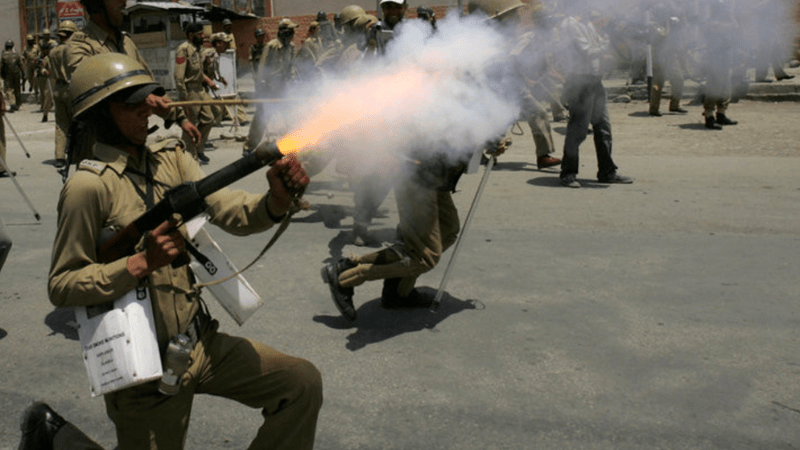
A soldier fires a weapon. Photo by Kashmir Global, used under CC BY 2.0 / Cropped from original. [Link to original image.] License details: CC BY 2.0 License
A Region in Perpetual Crisis
The abrogation of Article 370 intensified tensions in Jammu and Kashmir, especially among its Muslim majority, who viewed the move as further erosion of their rights.
Qadri described Article 370 as a “shield for India” to frame Kashmir as having “a lot of different rights”, enabling the country to deflect accusations of critics who describe the situation as an illegal military occupation.
Since the revocation, the region remains mired in a cycle of violence, repression, and failed diplomacy. Arrests and fatalities have surged, with over 3,800 Kashmiris arrested since 2019. The human toll is staggering, with over 40,000 Kashmiris killed in the past three decades, and thousands more missing –figures that reflect only what has been documented. Despite international calls for justice and self-determination, Kashmir’s future remains uncertain, trapped in a cycle of unrest and crisis.
Image credits: Cover photo by Steve Eason, used under CC BY 2.0 / Cropped from original. [Link to original image.] License details: CC BY 2.0 License
 Al-Hikmah

Leave a comment